

What's Happening?
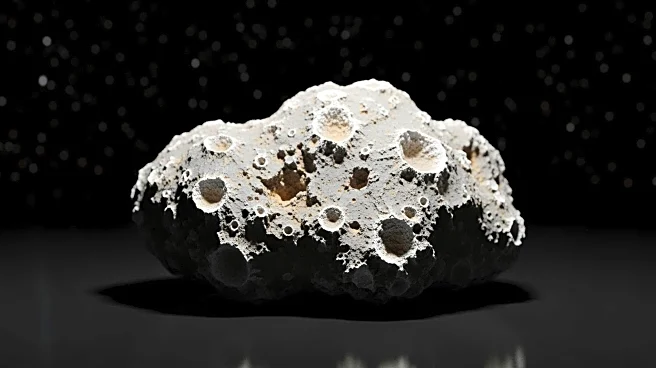
NASA's Psyche spacecraft is set to explore the asteroid 16 Psyche, located in the main asteroid belt between Mars and Jupiter. Psyche is the largest known metal-rich asteroid, measuring about 140 miles across. Researchers suspect it could be a remnant
of an early planet or a fragment of a once-layered body. The University of Arizona's Lunar and Planetary Laboratory has conducted simulations to understand how a large crater near Psyche's north pole may have formed. These simulations aim to provide predictions that will help interpret data collected by the Psyche mission. The research suggests that the asteroid's porosity plays a significant role in crater formation, affecting how impact energy is absorbed.
Why It's Important?
The Psyche mission could provide unprecedented insights into the early solar system's formation and the processes that shaped planetary bodies. Understanding Psyche's composition and structure may reveal information about the building blocks of planets and the violent collisions that occurred during their formation. The mission's findings could also enhance our knowledge of metal-rich asteroids, which are rare in the asteroid belt. This research has implications for planetary science, potentially informing future missions and the search for resources in space.
What's Next?
The Psyche spacecraft is scheduled to arrive at the asteroid in 2029. It will measure the asteroid's surface, gravity, magnetic field, and composition. The mission will involve collaboration among geochemists, geologists, and modelers to interpret the data collected. The findings could lead to new theories about planet formation and the role of metal-rich asteroids in the solar system. The mission is part of NASA's Discovery Program, highlighting the agency's commitment to exploring the solar system's mysteries.