



What's Happening?
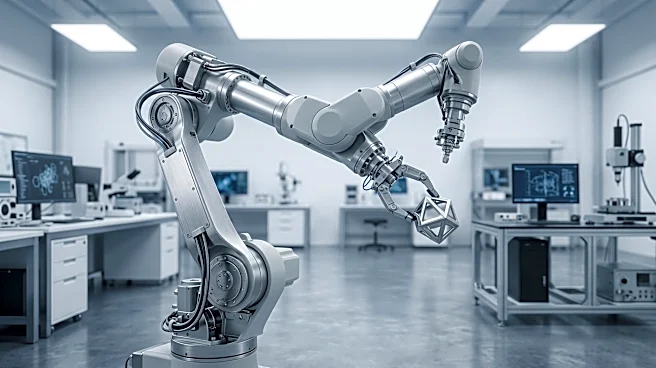
The Karlsruhe Institute of Technology (KIT) has launched the Energy Materials Acceleration Platform (E-MAP), a self-driving lab designed to significantly speed up the development of new functional materials. This platform automates key experimental steps,
allowing for the systematic examination, evaluation, and refinement of thousands of material variants. Dr. Holger Röhm from KIT's Light Technology Institute (LTI) stated that robot systems handle tasks such as material preparation, sample handling, thin-film deposition, and characterization, ensuring unprecedented precision and reproducibility. The E-MAP is a self-contained system capable of processing sensitive materials under controlled conditions and producing thin films from solution-based source materials. It also features a microfluidic system for automated synthesis and formulation of semiconductor inks. Professor Alexander Colsmann from KIT's LTI highlighted the modular design of E-MAP, which allows for the integration of new experiments and characterization methods, making it adaptable to various scientific problems and open to collaboration with external partners. The development of E-MAP began in 2023, with KIT allocating approximately EUR 600,000 for technical equipment, and the Carl Zeiss Foundation funding development activities as part of the KeraSolar research project.
Why It's Important?
The E-MAP represents a significant leap forward in materials science, addressing the bottleneck of conventional experimental methods that struggle with the vast number of material combinations required for new functional materials. By automating experiments and integrating precise material characterization, the platform can rapidly identify promising material compositions and production conditions. This acceleration in materials development has broad implications for various industries, particularly those focused on energy materials, where efficiency and performance are critical. Faster development cycles mean quicker innovation in areas like renewable energy, battery technology, and advanced electronics. The platform's ability to generate large amounts of experimental data, coupled with the intention to use AI methods for evaluation, will enable more effective data-driven research and autonomous screening processes. This approach not only reduces the time and cost associated with material discovery but also enhances the reliability and reproducibility of results, fostering a more robust scientific foundation for technological advancements.
What's Next?
The next phase for E-MAP involves the full integration of AI methods to evaluate the vast datasets generated by the automated experiments. This will enable researchers to identify promising material combinations through virtual simulations and control autonomous or semi-autonomous screening processes more effectively. The researchers aim to create a comprehensive research process that links synthesis, processing, characterization, and data evaluation, allowing for more data-driven experimental planning and execution. E-MAP is also integrated into the planned Helmholtz Acceleration Alliance (HELMA), which seeks to establish a network of autonomous research platforms across multiple Helmholtz Centers in materials science and life sciences. This broader network will facilitate collaborative research and accelerate discoveries on a larger scale. The modular design of E-MAP will continue to allow for the integration of new experiments and characterization methods, adapting to evolving scientific challenges and fostering partnerships with both academic and industrial entities.
Beyond the Headlines
The emergence of self-driving labs like E-MAP signifies a fundamental shift in the scientific discovery process, moving towards highly automated and AI-driven research. This trend has broader implications for scientific education and workforce development, as future scientists will need skills in robotics, data science, and artificial intelligence in addition to traditional scientific disciplines. The ability of these platforms to accelerate the discovery of new materials could also have geopolitical consequences, as nations compete to develop cutting-edge technologies for energy independence, defense, and economic growth. Ethical considerations regarding the responsible use of AI in scientific discovery, particularly in areas with potential dual-use applications, will also become increasingly important. Ultimately, self-driving labs could democratize access to advanced research capabilities, allowing smaller institutions or even individual researchers to conduct complex experiments that were previously only feasible in large, well-funded laboratories, thereby fostering a more inclusive and innovative scientific ecosystem.