
What's Happening?
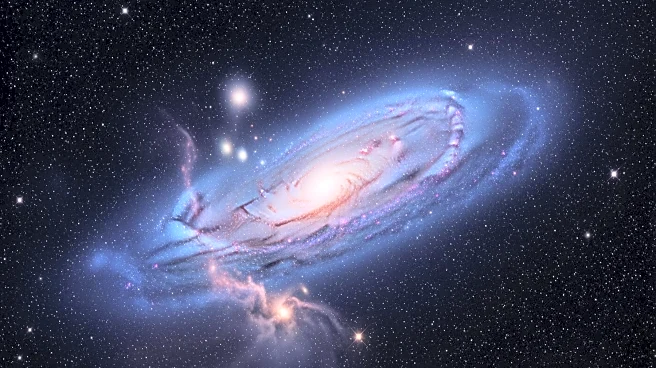
Indian astronomers have identified a remarkably old spiral galaxy, named 'Alaknanda', using the James Webb Space Telescope (JWST). This discovery was made during a study of galaxy shapes in the early universe,
led by Rashi Jain, a PhD student at the National Centre for Radio Astrophysics in Pune. The galaxy, which features two symmetrical spiral arms, was found in the UNCOVER survey data, which includes about 70,000 objects. The existence of Alaknanda, only 1.5 billion years after the Big Bang, challenges current models of galaxy formation, which suggest that stable, rotating disks necessary for spiral arms take billions of years to form. The findings were published in the journal Astronomy & Astrophysics.
Why It's Important?
The discovery of Alaknanda is significant as it challenges existing theories of galaxy formation, suggesting that spiral galaxies could form much earlier than previously thought. This could lead to a reevaluation of current models and simulations used to understand the universe's evolution. The findings highlight the capabilities of the JWST in providing high-quality data that can lead to groundbreaking discoveries. For the Indian scientific community, this discovery marks a notable achievement, showcasing the potential of Indian astronomers in contributing to major international scientific endeavors. It also underscores the importance of continued investment in astronomical research and international collaborations.
What's Next?
Further observations are planned to determine the mechanisms behind Alaknanda's formation. The research team intends to propose additional studies using the JWST or the Atacama Large Millimeter/submillimeter Array in Chile. These observations aim to confirm the galaxy's structure and explore whether its spiral arms formed through steady growth or interaction with another galaxy. The Indian astronomy community is also focusing on building domestic facilities and participating in large international projects to enhance its research capabilities and training programs.
Beyond the Headlines
The discovery of Alaknanda not only challenges scientific models but also highlights the need for a deeper understanding of complex systems in astronomy. It raises questions about the factors that could accelerate galaxy formation processes in the early universe. Additionally, this finding emphasizes the importance of photometric analysis in studying distant galaxies and the potential for future discoveries using advanced telescopes like the JWST.