
What's Happening?
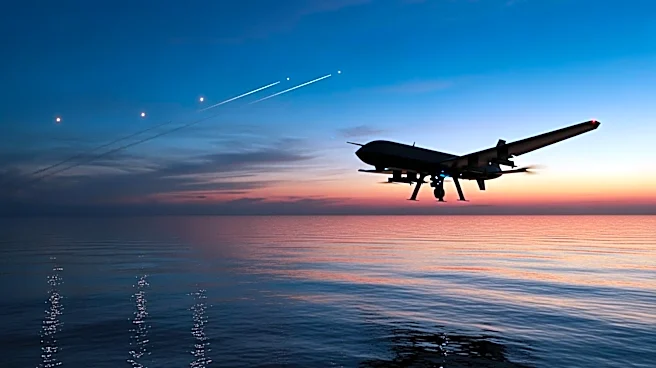
President Trump decided to halt 'Project Freedom' after Saudi Arabia refused to allow the use of its bases and airspace for a U.S. military operation aimed at escorting oil tankers through the Strait of Hormuz.
The operation was intended as a successor to the bombing campaign known as Operation Epic Fury. Despite a personal call between Saudi Crown Prince Mohammed bin Salman and President Trump, Saudi Arabia maintained its stance, citing concerns over the operation's potential to escalate into a naval confrontation with Iran. The refusal highlights Saudi Arabia's desire for a permanent resolution to the U.S.-Israel conflict with Iran, contrasting with the more assertive stance of the United Arab Emirates (UAE). The UAE, frustrated with Saudi Arabia's cautious approach, has already left OPEC and is considering exiting the Arab League.
Why It's Important?
The shelving of 'Project Freedom' underscores the complexities of Middle Eastern geopolitics and the challenges faced by the U.S. in securing regional cooperation. Saudi Arabia's decision reflects its strategic priorities and concerns over regional stability, particularly in light of potential Iranian retaliation. The move also highlights the growing rift between Saudi Arabia and the UAE, with the latter taking a more aggressive stance against Iran. This development could impact U.S. foreign policy and military strategy in the region, as well as the dynamics within the Gulf Cooperation Council. The situation also raises questions about the effectiveness of U.S. diplomatic efforts and the coherence of its strategy in the Middle East.
What's Next?
The U.S. may need to reassess its approach to the conflict with Iran and its reliance on regional allies like Saudi Arabia. The halt of 'Project Freedom' could lead to further diplomatic efforts to negotiate a ceasefire or a new agreement with Iran. Additionally, the U.S. might explore alternative strategies to ensure the security of oil shipments through the Strait of Hormuz. The growing tensions between Saudi Arabia and the UAE could also lead to shifts in regional alliances and impact the broader geopolitical landscape in the Middle East.
Beyond the Headlines
The decision to halt 'Project Freedom' may have long-term implications for U.S.-Saudi relations and the balance of power in the Gulf region. Saudi Arabia's reluctance to support the operation could be seen as a lack of confidence in U.S. leadership and strategy. This development might also influence other Gulf states' perceptions of U.S. commitments and their own security strategies. Furthermore, the situation highlights the potential for increased Iranian influence in the region if U.S. efforts to contain its activities are perceived as ineffective.