





What's Happening?
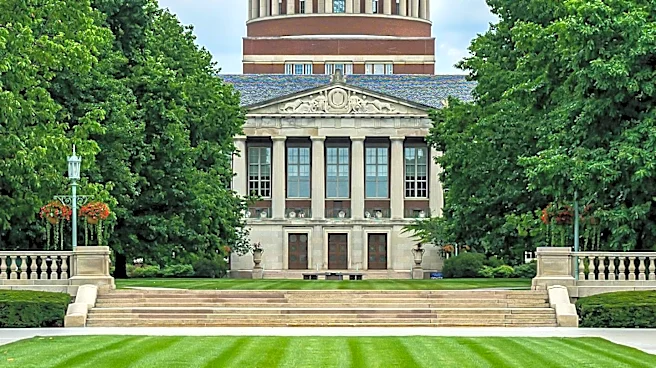
Researchers at the University of Rochester, led by Professor Anne S. Meyer, have developed a low-cost 3D bioprinter capable of creating living materials with over 100 layers. This innovation modifies a standard plastic 3D printer, costing only $450, by replacing
its plastic filament extruder with a syringe pump that dispenses bio-ink. The bio-ink, a mixture of living cells and a polymer solution, hardens into a gel. The team also created a support gel, or slurry, which helps the bio-ink solidify quickly and at various heights. Two types of slurry were developed: one for easy removal of the print and another for incubation, allowing microbes to remain viable for over four weeks, significantly longer than the nine days possible with previous methods. This advancement enables the creation of taller, more complex living structures, including those with hollow cavities, which was previously limited to less than 20 layers with DIY bioprinters.
Why It's Important?
This development significantly lowers the barrier to entry for scientific research in bioprinting, making advanced capabilities accessible to more labs due to the low cost and availability of parts. The ability to create living materials with a high surface-to-volume ratio means embedded bacteria can more efficiently interact with their environment, receiving signals or nutrients and excreting useful products faster. This is particularly important for studying biofilms, which are three-dimensional communities of microorganisms that can be both harmful and beneficial. The extended viability of microbes in the new slurry allows for more comprehensive and longer-term research into engineered biofilm materials, potentially leading to new antibacterial treatments, wastewater solutions, and materials with enhanced mechanical properties for various applications.
What's Next?
The instructions for building this customized bioprinter are available on the GitHub platform, encouraging other laboratories to replicate and further develop the technology. This open-source approach is expected to accelerate research in engineered living materials. Future applications could include creating materials for cleaning contaminated water, breaking down waste products like plastic, and developing new medical testing platforms for biofilms. The enhanced ability to control the shape and cellular composition of these living materials opens avenues for creating specialized structures tailored for specific biological or environmental functions, potentially leading to breakthroughs in biotechnology and environmental science.
Beyond the Headlines
The development of an affordable, high-capacity 3D bioprinter democratizes access to advanced research tools, potentially fostering innovation in smaller institutions and developing countries. This shift from expensive, proprietary equipment to accessible, DIY solutions could lead to a more collaborative and rapid pace of scientific discovery. Ethically, the ability to engineer living materials with specific cellular compositions raises questions about the responsible use and potential implications of creating novel biological systems. Legally, as these technologies become more widespread, frameworks for intellectual property and safety regulations for engineered living materials may need to evolve to address their unique characteristics and applications.