



What's Happening?
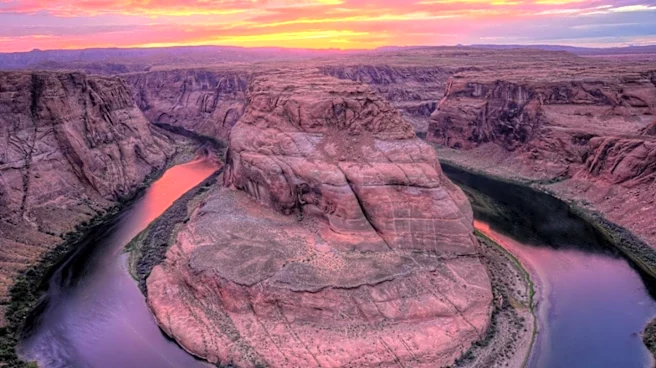
The federal government has finalized new rules for operating the Colorado River's largest reservoirs for the next two years, effective October 1. This plan, replacing guidelines from 2007, mandates significant water supply cuts for California, Arizona,
and Nevada, collectively known as the Lower Basin states. These states will lose 1.25 million acre-feet of water annually, impacting tribes, agriculture, and major cities like Phoenix and Los Angeles. Colorado and other Upper Basin states are spared from mandatory cuts, instead developing a smaller, voluntary conservation plan funded by the federal government. The decision comes as Lake Powell and Lake Mead are at historically low levels, with Lake Powell nearing 'minimum power pool,' a point where it cannot generate hydroelectric power.
Why It's Important?
This federal intervention is critical for the sustainability of the Colorado River, a vital water source for millions across the Western U.S. The mandated cuts highlight the severe impact of prolonged drought and climate change on water resources, forcing difficult allocation decisions. The plan's differential impact, with mandatory cuts for Lower Basin states and voluntary measures for Upper Basin states, underscores the complex political and environmental challenges in managing shared resources. The potential for Lake Powell to reach 'deadpool' status, where water is effectively trapped, poses a significant threat to hydroelectric power generation and water supply for millions. This situation could lead to increased water costs, agricultural disruptions, and potential legal disputes among states and tribal communities over water rights.
What's Next?
The finalized plan will be in place for 10 years, with specific conservation measures and water cuts likely re-issued every two years. The Lower Basin states, particularly Arizona, have criticized aspects of the plan, and some tribes, like the Gila River Indian Community, have indicated that drastic cuts could lead to litigation. While the plan is a short-term fix, California's lead negotiator, JB Hamby, stated that Upper Basin states would need to contribute more in the future. The Interior Secretary retains broad authority to impose harsher water cuts on Lower Basin states if drought conditions persist. This ongoing water crisis will likely spur continued negotiations, potential legal challenges, and efforts to develop more comprehensive, long-term agreements among all basin states to manage increasingly scarce water resources.
Beyond the Headlines
The Colorado River water crisis extends beyond immediate supply cuts, revealing deeper issues of climate adaptation, interstate cooperation, and environmental justice. The reliance on a 100-year-old compact for water allocation, established during a wetter period, is proving inadequate for current arid conditions. This situation forces a re-evaluation of historical water rights, particularly those of tribal nations, which have often been overlooked. The economic implications are vast, affecting agricultural practices, urban development, and energy production in a significant portion of the U.S. The federal government's role in imposing solutions highlights the limits of state-level negotiations and the necessity of a coordinated, basin-wide approach to climate resilience. This crisis serves as a stark reminder of the interconnectedness of environmental health, economic stability, and social equity in the face of climate change.