










What's Happening?
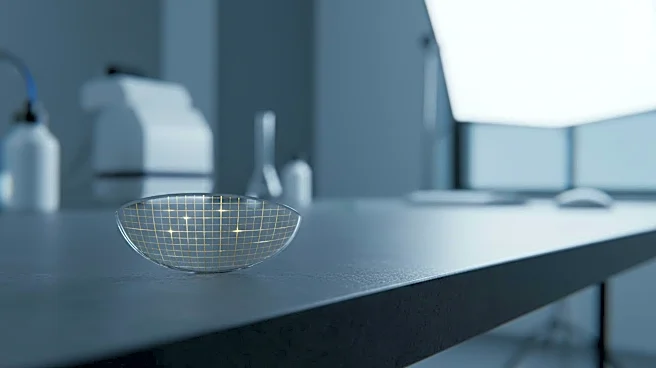
Researchers have developed a smart contact lens that incorporates a plasmonic nano-confinement nanowire array embedded with gold nanoparticles. This innovation aims to enable high-sensitivity, non-invasive monitoring of blood oxygen saturation (SpO2)
in the eyelid region. The study, published in the journal npj Flexible Electronics, highlights the use of conductive polymer nanowires integrated with gold nanoparticles to enhance photodetector sensitivity. The device is designed to measure transmitted light intensities under dual-wavelength illumination, calculating SpO2 values using Lambert-Beer’s law. Initial tests on human fingers and anesthetized rabbits have shown promising results, indicating the potential for continuous eyelid-capillary SpO2 monitoring.
Why It's Important?
The development of this smart contact lens represents a significant advancement in wearable health technology. By enabling non-invasive monitoring of blood oxygen levels directly from the eyelid, this device could provide a more convenient and less intrusive alternative to traditional methods, which typically involve bulky sensors attached to peripheral sites like fingers. This innovation could have substantial implications for clinical diagnostics, particularly in respiratory and cardiovascular health monitoring. The integration of plasmonic nanostructures into wearable devices also marks a step forward in the field of flexible bioelectronics, potentially leading to more sophisticated and user-friendly health monitoring solutions.
What's Next?
Future research will focus on enhancing the device's integration, wireless capabilities, and long-term stability. Additional testing will be required to validate the device's performance across a broader range of oxygen saturation levels and in various environmental conditions. The researchers aim to address current limitations, such as motion-artifact rejection and lens-fitting stability, to enable practical healthcare applications. Clinical trials involving human subjects will be necessary to further assess the device's efficacy and safety in real-world settings.