






What's Happening?
China's space program has evolved from a military-oriented project to a multi-domain venture, increasingly utilizing indigenous cosmology, myths, and historical scientific figures in its mission nomenclature. This strategic shift aims to project soft
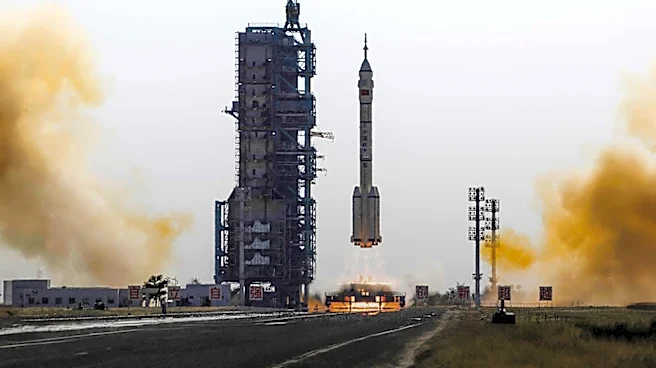
power and legitimize the vision of the 'great rejuvenation of the nation.' Unlike the Western space programs that traditionally draw from Greco-Roman mythology, China's approach offers an alternative symbolic lexicon, emphasizing technological autonomy and independent civilizational agency. Examples include the lunar exploration project named 'Chang'e' after the mythical goddess of harvest, and its rovers 'Yutu' (Jade Rabbit). The interplanetary program 'Tianwen' (Questions to Heaven) is inspired by a classical poem, with its Mars rover 'Zhurong' named after the mythical god of fire. Even the space station 'Tiangong' (Heavenly Palace) and its modules reflect ancient poetics. This cultural codification is actively internalized by Chinese society through public engagement in the naming process, fostering national cohesion and a great-power identity.
Why It's Important?
This strategic use of cultural narratives in China's space program has significant implications for global astropolitics and international relations. By anchoring its space endeavors in deep cultural heritage, China aims to present itself as a distinct technological civilization, offering an alternative to Western dominance in space exploration. This 'achievement-branding loop' leverages technological breakthroughs to reinforce a civilizational narrative, particularly appealing to the Global South. The promotion of critical assets like the BeiDou navigation network across these regions reinforces long-term technological interoperability and geopolitical alignment. Western policymakers are urged to recognize that China's competitive trajectory in space is driven not only by technological advancements but also by narrative diplomacy and strategic culture. Underestimating these civilizational dimensions could lead to a misjudgment of China's appeal in emerging markets and its domestic mobilizational capacity.
What's Next?
China is expected to continue its strategy of integrating cultural narratives into its space program, further solidifying its image as a leading space power with a unique civilizational identity. This approach will likely involve continued public engagement in naming future missions and hardware, reinforcing national pride and support for space initiatives. Diplomatically, China will likely intensify its efforts to export its vision across the Global South, promoting multilateral astronautic initiatives such as the International Lunar Research Station (ILRS). This will challenge the traditional Western-centric narrative of space exploration and potentially reshape international collaborations in space. The ongoing development of missions like the planned 'Gan De' mission to Jupiter and its moon system, named after an ancient Chinese astronomer, will further demonstrate this cultural-technological integration.
Beyond the Headlines
The cultural codification of China's space program represents a sophisticated form of soft power projection, aiming to influence global perceptions and establish a new paradigm in space exploration. This strategy goes beyond mere technological competition, delving into the realm of cultural diplomacy and identity formation. By drawing on ancient myths and historical figures, China is not just launching rockets; it is constructing a narrative of continuity between its past glories and future aspirations. This could lead to a more diverse and multi-polar astropolitical order, where different cultural frameworks shape the understanding and pursuit of space exploration. The emphasis on a 'community with a shared future for mankind' positions China as an inclusive architect of an alternative institutional architecture, potentially fostering new alliances and partnerships that challenge existing geopolitical structures. This approach also highlights the intrinsic link between national identity, technological prowess, and international influence in the 21st century.