



What's Happening?
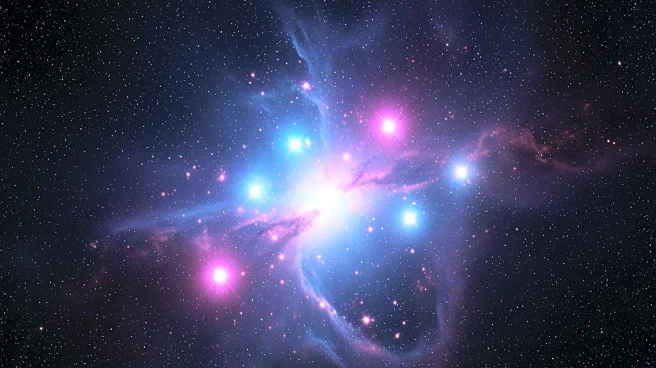
NASA's Hubble Space Telescope has captured a new image of the star-forming region NGC 1333, showcasing a variety of young stellar objects. The image features a protostar with a reflection nebula, surrounded by a protoplanetary disk where planets may form.
This disk casts a shadow across the surrounding material, though the exact boundary between the shadow and the disk remains unknown. Additionally, the image reveals a fan-shaped reflection nebula created by the stellar winds of two stars, HBC 340 and HBC 341, which are Orion variable stars known for their irregular brightness changes. These stars, along with others in the image, are part of the Perseus molecular cloud, located approximately 950 light-years away.
Why It's Important?
The Hubble image provides valuable insights into the early stages of star formation and the environments in which planets may form. Understanding the properties of circumstellar disks and the behavior of young stellar objects can enhance our knowledge of how solar systems develop. This research is crucial for astrophysics, as it helps scientists comprehend the processes that lead to the formation of stars and planets, potentially offering clues about the origins of our own solar system. The study of Orion variable stars, which are known for their unpredictable brightness, also contributes to our understanding of stellar evolution.
What's Next?
Future observations and studies will likely focus on further analyzing the properties of the circumstellar disks and the dynamics of the young stellar objects in NGC 1333. Researchers may use additional telescopes and instruments to gather more data on the variability of Orion variable stars and the impact of stellar winds on surrounding molecular clouds. These efforts aim to deepen our understanding of star and planet formation processes, potentially leading to new discoveries about the universe.
Beyond the Headlines
The study of young stellar objects and their environments not only advances scientific knowledge but also inspires technological innovations in telescope design and data analysis. The findings from such research can influence future space missions and the development of new observational techniques. Additionally, the cultural impact of these discoveries fosters public interest in space exploration and science education, encouraging the next generation of scientists and engineers.