
What's Happening?
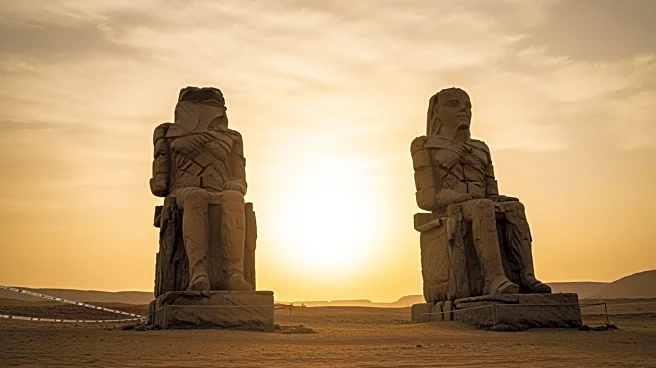
The Egyptian Ministry of Tourism and Antiquities has unveiled the newly restored Colossi of Memnon, monumental statues located at the entrance of the Luxor tomb of Pharaoh Amenhotep III. This restoration
marks the culmination of decades of work by an international team of archaeologists and conservators. Amenhotep III, who ruled from 1390 B.C.E to 1350 B.C.E., was a prominent figure during Egypt's New Kingdom. His tomb, which suffered damage from earthquakes and floods over centuries, has been a focus of restoration efforts since its discovery in 1799. The restoration project, which began in earnest in 2006, involved cleaning, restoring, and 3D-scanning the statues to ensure historical accuracy and longevity. The Colossi now stand at their original height of 45 feet, depicting Amenhotep III in royal attire. The project also uncovered nearly 300 additional sculptures and fragments, contributing to the understanding of ancient Egyptian art and culture.
Why It's Important?
The restoration of the Colossi of Memnon is significant for both cultural heritage and tourism in Egypt. These statues are not only historical artifacts but also symbols of Egypt's rich cultural past. The successful restoration enhances Egypt's appeal as a tourist destination, potentially boosting the local economy. Moreover, the project exemplifies international collaboration in preserving world heritage, involving experts from Germany, Japan, and the United States. The restoration also provides valuable insights into ancient Egyptian engineering and artistry, offering educational opportunities for scholars and the public. The unveiling of the Colossi is a testament to the importance of preserving cultural heritage for future generations.
What's Next?
Following the successful restoration of the Colossi of Memnon, the team plans to continue their work on other significant sites in Luxor. The next project involves restoring a statue at the tomb of Ramses II, another prominent pharaoh of ancient Egypt. Additionally, the team is assessing the preservation needs of the tomb of Queen Nefertari, with the goal of opening it to the public. These efforts are part of a broader initiative to conserve and promote Egypt's archaeological sites, ensuring their accessibility and educational value for future visitors. The ongoing work will likely attract further international interest and collaboration.