





What's Happening?
Transportation Secretary Sean Duffy announced on Sunday that the ability of air traffic control (ATC) routers to broadcast data has been turned off. This action is part of an ongoing investigation into a router communication issue that led to a nationwide
ground stop on Friday. According to Duffy, the specific router believed to have caused instability in the air traffic communication system, located in Arkansas, is currently being examined at an L3Harris lab in Florida. L3Harris is a government contractor providing technology and IT support to the Federal Aviation Administration (FAA). Duffy stated that 69 such routers in the national airspace have had their broadcasting capabilities disabled. The issue arose during work to replace outdated copper wire with fiber cables in El Dorado, Arkansas, which subsequently affected a system in Amarillo, Texas. The FAA, in collaboration with the FBI and other law enforcement agencies, is investigating the root cause, though officials currently have no indication of a cyberattack or sabotage.
Why It's Important?
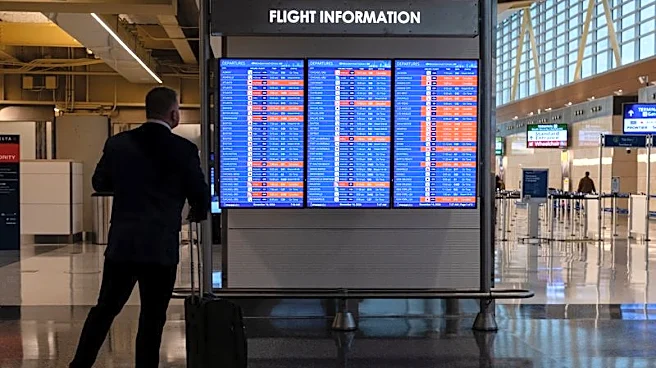
This incident highlights critical vulnerabilities within the nation's aging air traffic control infrastructure. A nationwide ground stop, a rare occurrence, severely disrupted air travel, impacting millions of passengers and causing significant economic losses for airlines and related industries. The investigation into whether the issue was due to incompetence, user error, installer error, or a faulty router from L3Harris underscores the importance of robust quality control and maintenance protocols for critical national systems. The event also brings to the forefront the ongoing debate about funding for modernizing the ATC system. Secretary Duffy has reiterated calls for Congress to appropriate tens of billions of dollars for a complete overhaul, arguing that current funding is insufficient for telecom architecture and new software systems. The reliability of air travel, a cornerstone of the U.S. economy and daily life, depends on a resilient and modern ATC system, making this investigation and subsequent upgrades crucial for national security and economic stability.
What's Next?
The investigation into the router communication issue will continue, with the specific routers from Arkansas and Texas being analyzed at the L3Harris lab in Florida, with FAA and FBI teams on-site. Officials will aim to determine the precise root cause of the instability, whether it was human error, a faulty component, or another factor. Secretary Duffy is expected to continue advocating for increased congressional funding to modernize the nation's air traffic control system, specifically for new telecom architecture and software. However, Democrats, including Rep. Rick Larsen and Rep. André Carson, have expressed skepticism regarding the funding request, citing that a significant portion of previously appropriated funds remains unobligated and unspent. The outcome of the investigation could influence future contracting practices with companies like L3Harris and potentially lead to new legislative efforts to secure funding for infrastructure upgrades. The FAA will likely implement any necessary procedural or technological changes identified during the investigation to prevent similar disruptions.
Beyond the Headlines
The incident exposes a deeper systemic challenge within U.S. infrastructure: the persistent underfunding and delayed modernization of critical national systems. While the immediate focus is on air traffic control, this event serves as a stark reminder of similar vulnerabilities across various sectors, from energy grids to public transportation. The reliance on aging technology, as highlighted by the transition from copper to fiber, presents ongoing risks that can have cascading effects on the economy and public trust. The debate over funding also touches upon broader political dynamics, with calls for bipartisan cooperation on infrastructure contrasted with scrutiny over the utilization of existing appropriations. This situation could catalyze a more comprehensive national dialogue on infrastructure investment, accountability in government contracting, and the long-term strategic planning required to maintain essential services in an increasingly complex technological landscape. The incident also implicitly raises questions about the resilience of interconnected systems and the potential for single points of failure to trigger widespread disruption.