




What's Happening?
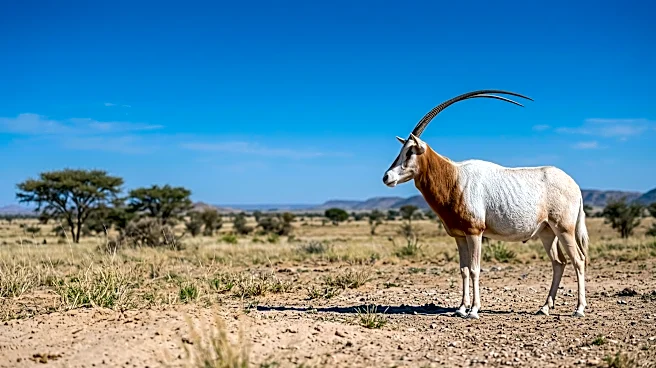
The scimitar-horned oryx, once declared extinct in the wild in 2000, has seen a remarkable comeback in Chad. A decade after 25 captive-bred oryx were reintroduced, the free-living population now exceeds 600 animals. This recovery led the International
Union for Conservation of Nature (IUCN) to reclassify the species from 'Extinct in the Wild' to 'Endangered' in December 2023. The reintroduction program, which began in March 2016, involved transporting animals from Abu Dhabi to the Ouadi Rimé-Ouadi Achim Faunal Reserve in Chad. The initiative is a collaborative effort involving the Environment Agency-Abu Dhabi, Sahara Conservation, the Government of Chad, and international partners including the Smithsonian's National Zoo and Conservation Biology Institute. The program focused on establishing a self-sustaining population, with the first wild-born calf recorded in December 2016. By 2023, over 500 calves had been born in the wild, contributing significantly to the population growth.
Why It's Important?
This successful reintroduction of the scimitar-horned oryx highlights the critical role of international cooperation, captive breeding, and habitat protection in species conservation. The reclassification from 'Extinct in the Wild' to 'Endangered' offers a tangible example of how dedicated conservation efforts can reverse the fortunes of species on the brink. For the U.S., institutions like the Smithsonian's National Zoo and Conservation Biology Institute played a vital role, demonstrating American expertise and commitment to global biodiversity. This success story provides a blueprint for future conservation projects, offering hope and practical strategies for other endangered species. It also underscores the economic and ecological value of preserving biodiversity, as healthy ecosystems contribute to global stability and resource availability. The project's challenges, such as significant deaths during a 2024 dry season, also emphasize the ongoing need for vigilance and adaptive management in conservation.
What's Next?
The future of the scimitar-horned oryx depends on continued monitoring and protection of its habitat. Conservation teams will persist in using satellite tracking and field surveys to observe movements, reproduction, distribution, and survival rates. The species remains 'Endangered,' indicating that ongoing conservation efforts are crucial to prevent a regression. The program's success could inspire similar initiatives for other species facing extinction, potentially leading to increased international collaboration and funding for wildlife conservation. Stakeholders, including governments, conservation organizations, and local communities, will need to maintain their commitment to habitat preservation and anti-poaching measures. The experience gained from this project will likely inform policy decisions and conservation strategies globally, particularly in regions with vulnerable wildlife populations.
Beyond the Headlines
The scimitar-horned oryx's journey from extinction in the wild to an endangered status carries profound ethical and cultural implications. It demonstrates humanity's capacity not only to cause environmental degradation but also to actively reverse it through concerted effort. This narrative challenges the perception of irreversible loss in conservation, offering a powerful message of hope and responsibility. The project also highlights the complex interplay between scientific research, political will, and community engagement required for such large-scale ecological restoration. Furthermore, the genetic diversity maintained through a 'world herd' in Abu Dhabi underscores the importance of international genetic resource management for species survival. This success could foster a greater appreciation for biodiversity and encourage more proactive measures to protect natural habitats, recognizing their intrinsic value beyond immediate human utility.