
What's Happening?
China has formally protested the Philippines' announcement to open a new trade office in Cebu, Taiwan's second in the country. Chinese Foreign Ministry spokesperson Guo Jiakun urged the Philippines to uphold
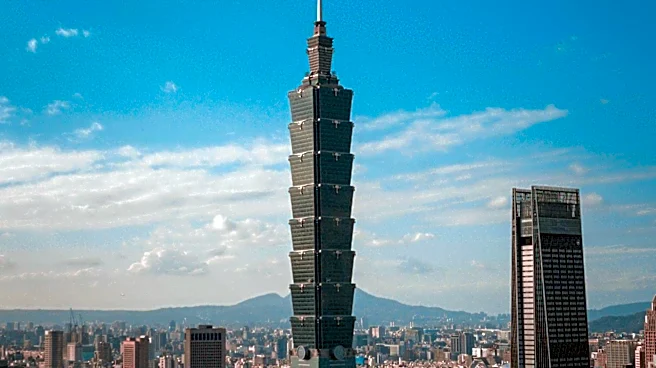
the 'one-China Principle' through 'concrete actions' and avoid damaging relations with China. Taiwan's Foreign Minister Lin Chia-lung stated that the new office would serve travelers and businesses in the central Philippines and be part of a proposed Taiwan-Philippines Economic Corridor. This development follows Taiwan's donation of a decommissioned patrol vessel to the Philippines' coast guard. Analysts suggest that China's pressure in the South China Sea is accelerating existing trends in Philippines-Taiwan relations, which are driven by economic links, labor, geographical proximity, and supply-chain cooperation. The Philippine Department of Foreign Affairs responded that Manila's one-China policy remains unchanged but does not prevent economic, cultural, and functional cooperation with Taiwan. Philippine Defense Secretary Gilberto Teodoro Jr. emphasized that Manila defines its own one-China policy.
Why It's Important?
The escalating tensions surrounding the Philippines' decision to open a new trade office in Taiwan highlight the complex and evolving geopolitical landscape in the Indo-Pacific region. China's strong reaction underscores its unwavering commitment to the 'one-China Principle' and its sensitivity to any actions perceived as supporting Taiwan's independence. For the U.S., this situation is important as it navigates its own 'one-China policy' while maintaining unofficial relations and acting as Taiwan's main security guarantor. The U.S. has a vested interest in regional stability and the freedom of navigation in the South China Sea, where China's assertive actions are a point of contention. The strengthening of economic and security ties between the Philippines and Taiwan, partly in response to Chinese pressure, could lead to a more robust regional alliance structure that aligns with U.S. strategic interests in counterbalancing China's influence. However, it also risks further antagonizing Beijing and potentially increasing regional instability, impacting U.S. diplomatic efforts and military presence in the area.
What's Next?
The Philippines is expected to proceed with the opening of the trade office, maintaining its stance that such actions do not violate its 'one-China policy' and are focused on economic and cultural cooperation. China will likely continue to monitor and potentially issue further diplomatic protests or take other measures to express its displeasure, though the specific nature of these actions remains to be seen. The proposed Taiwan-Philippines Economic Corridor will likely move forward, further integrating the economies of the two entities. This situation could also prompt other nations in the region to re-evaluate their own 'one-China policies' and their engagement with Taiwan, potentially leading to a broader shift in regional diplomatic and economic alignments. The U.S. will continue to observe these developments closely, likely reiterating its commitment to regional peace and stability while maintaining its nuanced approach to Taiwan. Future interactions between the Philippines and China, particularly regarding maritime disputes in the South China Sea, will be influenced by this growing alignment between Manila and Taipei.
Beyond the Headlines
This incident reveals a deeper trend of smaller nations in the Indo-Pacific region increasingly asserting their autonomy and forging closer ties with Taiwan, despite Beijing's pressure. The Philippines' willingness to define its 'one-China policy' on its own terms, rather than strictly adhering to Beijing's interpretation, signifies a growing confidence among some countries to push back against China's coercive diplomacy. This could lead to a gradual erosion of China's ability to dictate the terms of engagement with Taiwan for other nations. Furthermore, the emphasis on economic corridors and supply-chain cooperation highlights a strategic pivot towards strengthening regional economic resilience and reducing dependence on China. This shift could have long-term implications for global supply chains and regional economic integration, potentially fostering new alliances and trade blocs that challenge existing power dynamics. The ethical dimension lies in the right of sovereign nations to conduct their foreign policy and economic relations without undue external pressure, a principle that is being tested in this evolving regional dynamic.