





What's Happening?
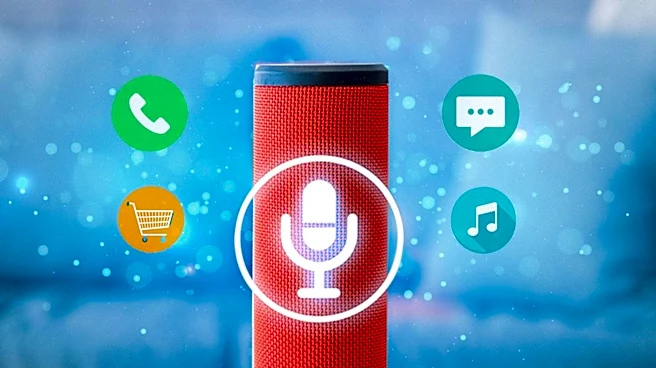
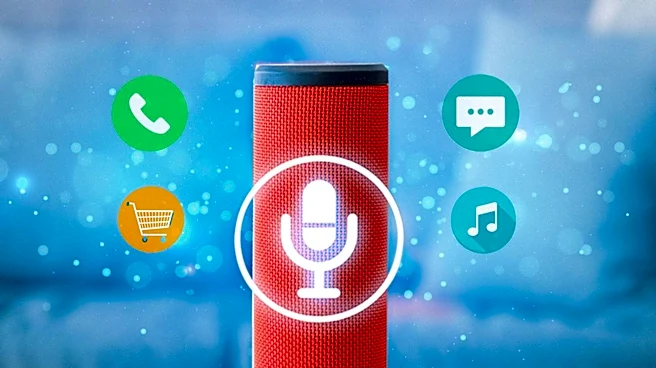
Voice interfaces are on the cusp of a significant renaissance, fundamentally changing how humans interact with computers. This shift is driven by advancements in neural networks, such as the transformer architecture behind systems like ChatGPT, and sophisticated
speech-recognition models like OpenAI's Whisper. These technologies enable computers to understand natural language, reason beyond basic commands, and accurately transcribe spoken words across various accents and conditions. The new era of voice interfaces will manifest in diverse forms, including speaking to input text into any application, systems that passively listen and take notes, and the removal of friction from numerous workflows, both white-collar and blue-collar. This marks a departure from traditional interfaces like keyboards and mice, moving towards a more natural and intuitive communication method.
Why It's Important?
The impending renaissance in voice interfaces holds profound implications for U.S. industries, workforce dynamics, and daily life. For businesses, this technology can streamline operations, enhance productivity, and reduce manual input errors across sectors ranging from customer service to manufacturing. The ability to inject text into any app via voice, or for systems to passively take notes, could revolutionize how professionals draft emails, manage projects, and conduct meetings. In blue-collar environments, voice commands could simplify inventory tagging and other hands-on tasks, improving efficiency and safety. For the general public, this means more accessible and intuitive technology, potentially benefiting individuals with disabilities or those who find traditional interfaces challenging. However, it also raises questions about data privacy, the security of voice data, and the potential for job displacement in roles heavily reliant on manual data entry or transcription. The U.S. tech sector, a leader in AI development, stands to gain significantly from this innovation, but also faces the challenge of integrating these technologies responsibly and ethically.
What's Next?
The future of voice interfaces will involve a continuous push towards more natural and intelligent interactions. Key developments include the refinement of full-duplex voice systems that can listen and speak simultaneously, mimicking human conversation by understanding interruptions and nuanced vocal cues. This will require advanced AI to differentiate between a pause and a completed thought, and to respond appropriately. Companies like OpenAI are already exploring architectures that separate fast conversational layers from slower, deeper reasoning systems (e.g., GPT-Live) to maintain conversational flow while allowing for complex thought processes. Further advancements will focus on improving accuracy in challenging environments, such as multi-person conversations requiring diarization (identifying who spoke when). The goal is not necessarily perfect transcription, but rather interfaces that recognize their own uncertainty and can clarify when needed, making human-computer interactions more robust and reliable.
Beyond the Headlines
The re-emergence of voice as a primary interface taps into a deep-seated human instinct for oral communication, challenging centuries of reliance on written and visual mediums. This shift could fundamentally alter cognitive processes, potentially reducing the emphasis on precise written articulation in favor of more fluid, spoken thought. While typing encourages structured, deliberate thinking, dictation allows for a more uninhibited flow of ideas, with AI systems tasked with parsing intent from less-formed thoughts. This raises philosophical questions about the nature of thought itself and how our tools shape our minds, as famously posited by Marshall McLuhan. Culturally, it could lead to a revaluation of oral traditions, once considered elite, and a blurring of lines between human and machine communication. The ethical considerations extend to the potential for AI to interpret and even anticipate human intent, raising concerns about autonomy, manipulation, and the very definition of human agency in an increasingly voice-interfaced world.