





What's Happening?
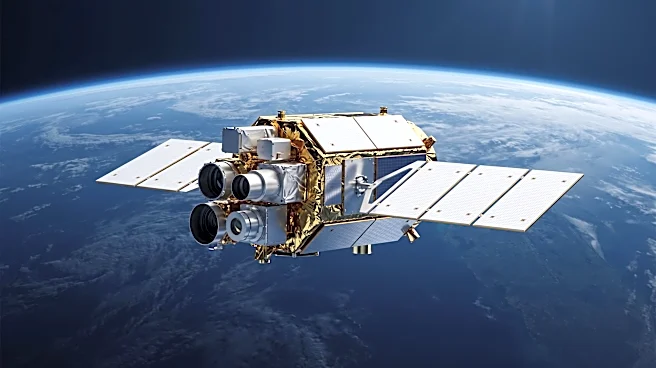
NASA has officially ended its efforts to save the Neil Gehrels Swift Observatory after failing to adjust the telescope’s altitude above Earth. The observatory conducted its final observation on October 20 and is expected to reenter Earth’s atmosphere
within the next few weeks. Launched on November 20, 2004, Swift was designed as a multiwavelength observatory to rapidly image gamma-ray bursts and pinpoint their locations, allowing scientists to study these brief cosmic outbursts before they faded. Over its mission, Swift observed more than 2,000 gamma-ray bursts, over 1,400 supernova explosions, detected stars being shredded by black holes, monitored active galaxies, and conducted an all-sky X-ray survey. Its data has contributed to approximately 7,000 published scientific papers.
Why It's Important?
The conclusion of the Swift Observatory's mission marks the end of an era for gamma-ray burst astronomy and high-energy astrophysics. Swift revolutionized the study of these powerful cosmic events by providing rapid and precise localization, enabling follow-up observations across the electromagnetic spectrum. This capability significantly advanced our understanding of the universe's most extreme phenomena, including the formation of black holes and neutron stars. The vast archive of data collected by Swift will continue to be a valuable resource for scientists for decades, fueling new discoveries and research. Its success also underscores the importance of long-duration space missions and the return on investment in scientific exploration, demonstrating how instruments designed for specific tasks can evolve into versatile tools for broader astronomical research.
What's Next?
The Neil Gehrels Swift Observatory is anticipated to reenter Earth’s atmosphere in the coming weeks, marking its physical end. However, its scientific legacy will continue through the extensive data archive it has compiled over two decades. Researchers worldwide will continue to analyze this data, leading to new insights and discoveries in astrophysics. The lessons learned from Swift’s operational success, particularly its rapid response capabilities and multiwavelength approach, will inform the design and implementation of future space telescopes and astronomical missions. NASA and other space agencies will likely focus on developing new technologies and observatories to continue the exploration of high-energy cosmic phenomena, building upon the foundation laid by Swift.
Beyond the Headlines
The decommissioning of the Swift Observatory highlights the inherent challenges and finite lifespans of space missions. While Swift's reentry is a natural conclusion to its operational life, it also raises broader discussions about space debris and the sustainable use of Earth's orbit. The mission's success in exceeding its planned operational lifespan by more than tenfold is a testament to engineering resilience and dedicated mission control, but it also prompts reflection on how to maximize the scientific output of such assets. Furthermore, Swift's contributions to understanding the most energetic events in the universe have profound implications for our comprehension of fundamental physics and the evolution of the cosmos, pushing the boundaries of human knowledge and inspiring future generations of scientists and engineers.