





What's Happening?
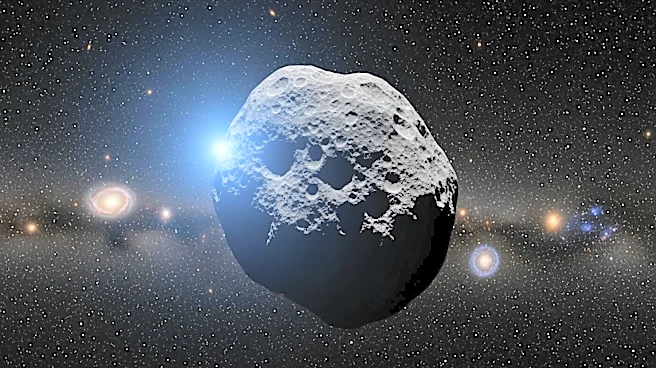
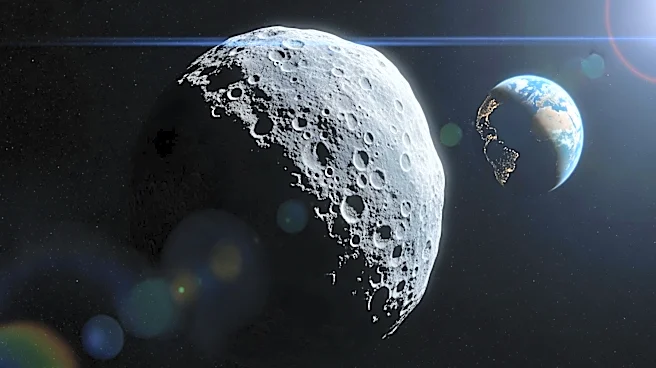
NASA is closely monitoring an asteroid named Apophis, which is set to make a 'very rare' close approach to Earth on April 13, 2029. Apophis, with a mean diameter of 1,115 feet and a long axis of at least 1,480 feet, will pass within 20,000 miles of Earth's
surface. This distance is closer than many satellites in geosynchronous orbit, which are about 22,236 miles away. Such a close encounter with an asteroid of this size is an event that occurs only every few thousand years. Although Apophis is classified as a 'potentially hazardous' asteroid, NASA assures that it poses no immediate threat to Earth. The agency plans to use this opportunity to study the asteroid in detail, as it will be the closest approach by an asteroid of this size that scientists have been able to predict in advance.
Why It's Important?
The close approach of Apophis presents a unique opportunity for scientific study. NASA aims to gather data on the asteroid's physical characteristics and behavior during its encounter with Earth's gravitational field. This event allows scientists to observe how Apophis's orbit, rotation, and surface might be affected by Earth's gravity. Understanding these dynamics can provide insights into the internal structure and composition of Apophis, which can be extrapolated to other near-Earth asteroids. Such knowledge is crucial for planetary defense strategies and for assessing potential future threats from similar space objects. Additionally, the event underscores the importance of continued investment in space observation technologies to monitor and study celestial bodies that could impact Earth.
What's Next?
As the 2029 approach date nears, NASA and other space agencies will likely increase their observational efforts to gather as much data as possible. This may involve deploying additional telescopes and possibly spacecraft to study Apophis up close. The data collected will be analyzed to refine models of the asteroid's trajectory and physical properties. The scientific community will be keenly interested in the results, which could influence future asteroid monitoring and mitigation strategies. Public interest in the event is also expected to grow, potentially leading to increased support for space exploration and research initiatives.