






What's Happening?
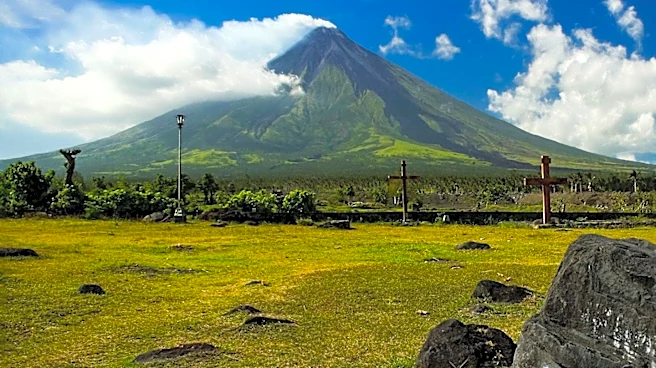
The Philippine Institute of Volcanology and Seismology (PHIVOLCS) has elevated the alert level for Mount Mayon from level 2 to level 3 after the volcano experienced a moderate eruption on October 30. This eruption produced a thick column of ash that ascended
to a height of 3,000 meters. The ash plume, carried by moderate winds, is projected to potentially affect residential areas in Daraga, Guinobatan, and other nearby towns within Albay province. Consequently, PHIVOLCS has issued an urgent advisory for residents to evacuate from the danger zone, specifically within a 6-kilometer radius around the volcano, due to the heightened risks of lava flows and rockfalls. Airlines have also been cautioned to avoid flying near the volcano's summit to prevent hazards posed by the ash. No casualties or property damage have been reported immediately following the eruption.
Why It's Important?
The eruption of Mount Mayon and the subsequent evacuation orders underscore the significant geological risks faced by populations living near active volcanoes. For the U.S., this event serves as a critical reminder of the importance of robust geological monitoring systems and effective disaster preparedness strategies, particularly in regions with volcanic activity like Hawaii and the Pacific Northwest. The potential for ashfall to impact residential areas and aviation highlights the far-reaching consequences of volcanic eruptions beyond immediate lava flows. The economic implications include potential disruptions to air travel, agricultural losses due to ashfall, and the costs associated with emergency evacuations and providing temporary shelter for displaced residents. The event also emphasizes the role of scientific agencies like PHIVOLCS in providing timely warnings and guidance to protect public safety and mitigate potential damage.
What's Next?
Following the alert level increase and evacuation orders, PHIVOLCS will continue to closely monitor Mount Mayon for further volcanic activity. Residents in the designated danger zones are expected to comply with evacuation directives, and emergency services will be on standby to assist. The agency has also warned of the possibility of volcanic mud (lahar) and other dangerous phenomena in the coming days, indicating that the situation remains dynamic and potentially escalating. Airlines will likely maintain their advisories to avoid the airspace near the volcano, which could lead to continued flight disruptions in the region. The focus will be on ensuring the safety of the affected communities and providing necessary support, while scientists gather more data to predict the volcano's future behavior.
Beyond the Headlines
The ongoing situation at Mount Mayon brings to light the complex interplay between natural hazards and human settlement, particularly in densely populated areas. The cultural significance of volcanoes in many communities, including those in the Philippines, often intertwines with the practical challenges of living in their shadow. This event also highlights the ethical considerations involved in balancing economic development with the inherent risks of natural disasters. The long-term psychological impact on evacuated communities, who may face uncertainty about returning home and potential loss of livelihoods, is a less visible but significant consequence. Furthermore, the eruption contributes to the broader scientific understanding of volcanic processes, which is crucial for improving global hazard prediction models and informing policy decisions related to land use and disaster resilience in volcanic regions worldwide.