




What's Happening?
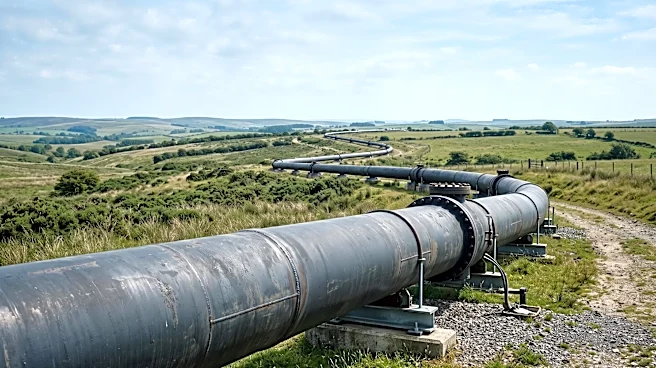
China has commissioned its longest carbon dioxide (CO2) transmission pipeline, a 277.6-kilometer project in Northeast China, marking a significant advancement in the country's carbon capture, utilization, and storage (CCUS) infrastructure. Operated by
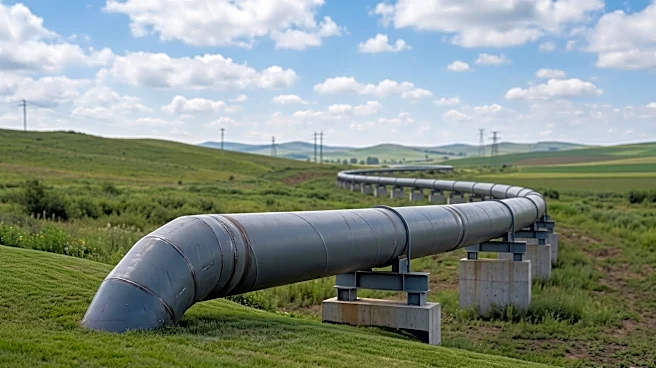
China National Petroleum Corporation (CNPC), the Jilin Petrochemical-Jilin Oilfield pipeline is designed to transport up to 3.3 million metric tons of CO2 annually. This project sets national records for transmission distance, pipe diameter, design pressure, and annual transport capacity. The pipeline connects upstream carbon capture facilities at Jilin Petrochemical with downstream injection and storage sites at Jilin Oilfield, where the captured CO2 will be used for enhanced oil recovery (EOR) and geological storage. This initiative underscores China's increasing focus on decarbonizing high-emission industries.
Why It's Important?
The commissioning of this record-breaking CO2 pipeline is a critical step in China's efforts to mitigate carbon emissions and develop a robust CCUS industry. For the U.S., this development highlights the global race in climate technology and infrastructure. While the U.S. also invests in CCUS, China's rapid deployment of large-scale projects like this pipeline demonstrates a significant commitment to addressing climate change through technological solutions. This could influence U.S. policy and investment in CCUS, potentially spurring further domestic development to maintain competitiveness in green technologies. The success of such projects in China could also provide valuable lessons and best practices for U.S. companies and policymakers exploring similar large-scale carbon management initiatives, particularly in linking industrial emitters with storage sites.
What's Next?
CNPC plans to develop a regional CCUS industrial network around this new pipeline, envisioning it as a 'carbon artery' that connects various carbon capture, transportation, utilization, and storage operations. The pipeline's annual design capacity of 3.3 million metric tons exceeds the current output of Jilin Petrochemical's CO2 recovery facility (800,000 metric tons), indicating room for future expansion and the connection of additional carbon dioxide sources. This suggests a long-term strategy for scaling up CCUS in China. For the U.S., this ongoing development in China could intensify discussions around federal funding for CCUS projects, regulatory frameworks for CO2 pipelines, and incentives for industrial decarbonization. It may also encourage greater international collaboration or competition in carbon management technologies.
Beyond the Headlines
The strategic development of CCUS infrastructure like this pipeline in China has broader implications for global energy markets and environmental policy. It signifies a move towards integrating carbon management into industrial processes, potentially altering the economic viability of certain high-emission industries. For the U.S., this could mean a re-evaluation of its own industrial policies and a push for more aggressive decarbonization targets to remain competitive and meet climate goals. Furthermore, the use of captured CO2 for enhanced oil recovery raises questions about the true 'net zero' impact of such technologies, as it can prolong fossil fuel extraction. This dual-use approach presents a complex ethical and environmental debate that will likely continue to evolve as CCUS technologies become more widespread globally.