





What's Happening?
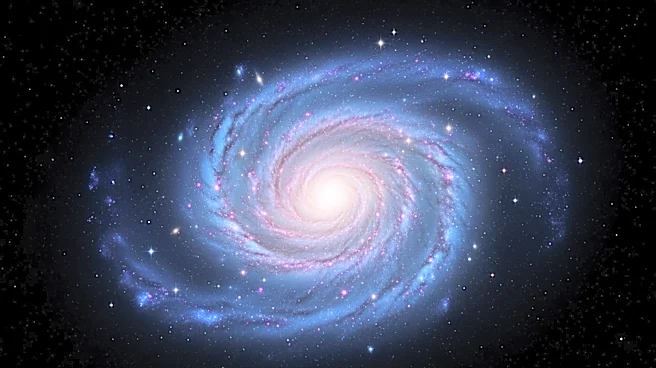
NASA's James Webb Space Telescope has captured a striking image of the Messier 77 galaxy, located 45 million light-years away in the Cetus constellation. The image highlights the galaxy's active nucleus, which is powered by a supermassive black hole eight
million times more massive than the sun. This black hole draws surrounding gas into a tight orbit, heating it to extreme temperatures and causing it to radiate brightly. The Webb Telescope, which has been operational since 2021, used its mid-infrared instrument to capture these details, showcasing the galaxy's brilliant heart.
Why It's Important?
The image of Messier 77 provides valuable insights into the dynamics of galaxies and the role of supermassive black holes in their centers. Understanding these processes is crucial for astronomers as they study galaxy formation and evolution. The Webb Telescope's ability to capture such detailed images enhances our knowledge of the universe and supports ongoing research in astrophysics. This development is significant for the scientific community, as it offers a deeper understanding of cosmic phenomena and the forces shaping galaxies.