






What's Happening?
South America is emerging as a critical region for the global supply of copper and lithium, essential minerals for electrification and energy storage. According to Mario Saavedra, GM of Multotec Chile and Peru, the region, including Argentina, Chile,
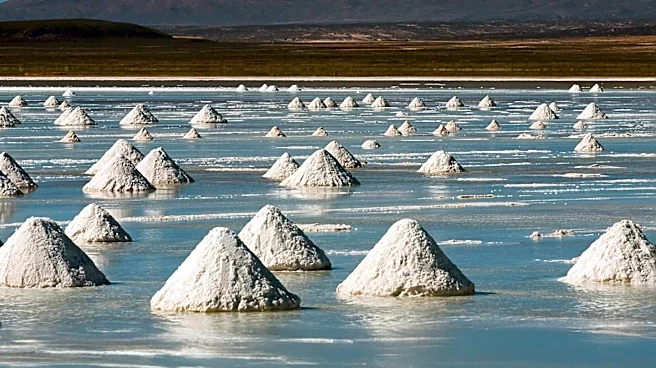
and Bolivia, is consolidating its position within the world's lithium triangle, which holds significant lithium brine resources. Recent projections from the CESCO Week 2025 mining forum suggest that South America could account for 34% to 48% of global copper supply in the coming decades. However, despite aggressive investment scenarios, a structural copper deficit is anticipated by 2050. The region faces challenges such as declining ore grades, ageing assets, and increasing ore hardness, which are reshaping operational priorities. Additionally, new lithium projects are under pressure due to water use, permitting timelines, and infrastructure readiness.
Why It's Important?
The strategic importance of South America in the global mining sector is underscored by its potential to stabilize copper and lithium supplies, which are crucial for the global economy. The demand for these minerals is driven by the electrification of transport, renewable energy infrastructure expansion, and battery manufacturing. However, the region's ability to meet this demand is threatened by execution challenges, including permitting timelines, infrastructure constraints, and political uncertainty. These factors could impact the economic viability of mining projects and the region's ability to capitalize on its mineral resources. The focus on operational execution and processing efficiency is becoming as important as resource scale, highlighting the need for strategic operational performance.
What's Next?
The mining industry in South America is approaching a critical inflection point, with copper supply projected to peak around 2036 before declining. This timing coincides with accelerating global demand, emphasizing the need for efficient execution of mining projects. The industry must address challenges such as water management, power availability, and operational stability to achieve production targets and ensure long-term economic viability. Stakeholders, including governments and mining companies, will need to collaborate to overcome these hurdles and optimize the region's mining potential.
Beyond the Headlines
The shift towards more complex mineral processing routes in South America reflects broader trends in the mining industry, where operational efficiency is becoming a key determinant of success. This transition highlights the importance of technological advancements and innovation in mining operations. Additionally, the social acceptance of mining projects is increasingly critical, as communities demand sustainable practices and environmental stewardship. The region's ability to balance economic growth with environmental and social responsibilities will be crucial in maintaining its strategic position in the global mining sector.