




What's Happening?
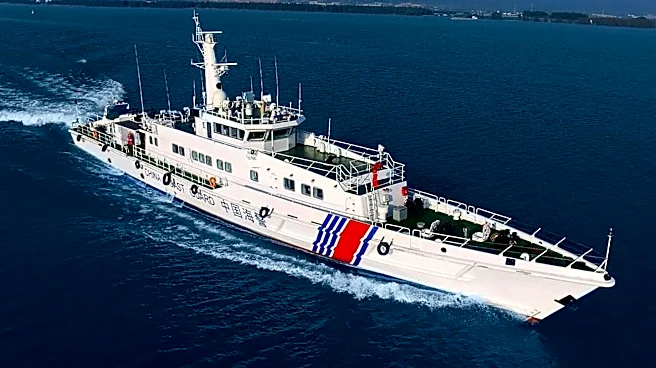
The Philippine Coast Guard (PCG) is actively monitoring a Chinese research vessel, identified as Jia Hai Ke 7, along with two China Coast Guard vessels, as they operate near the boundary of the Philippines’ exclusive economic zone (EEZ). Simultaneously,
three Taiwan Coast Guard vessels are also observing the Chinese ship's movements. PCG spokesperson Rear Admiral Jay Tarriela stated that the Chinese vessel's repeated stops and stationary movements are consistent with marine scientific research, which the Philippines has not authorized. The Department of Foreign Affairs (DFA) has rejected China's assertion of sovereign rights over these waters. Tarriela clarified that the PCG did not coordinate with the Taiwan Coast Guard, suggesting Taiwan may be using automatic identification system (AIS) data from Philippine vessels for tracking.
Why It's Important?
This incident highlights escalating maritime tensions in the South China Sea and the Luzon Strait, areas critical for international shipping and rich in natural resources. The unauthorized marine scientific research by a Chinese vessel within the Philippine EEZ challenges the Philippines' sovereign rights and international maritime law. The involvement of the Taiwan Coast Guard, even without direct coordination, underscores the broader regional concern over China's maritime activities. For the United States, a treaty ally of the Philippines, these developments are significant as they impact regional stability and freedom of navigation. The potential for dual-use research, where scientific data could have military applications, raises security concerns for critical infrastructure like subsea cables, which are vital for global telecommunications.
What's Next?
The Philippine Coast Guard will likely continue to monitor the Chinese vessels and challenge any unauthorized activities within its EEZ. Diplomatic exchanges between the Philippines and China are expected to persist, with the Philippines reiterating its position on sovereign rights and international law. The incident may prompt further discussions among regional allies, including the United States, on strategies to address China's maritime assertiveness. The focus will remain on whether the Chinese vessel ceases its activities or if further actions, such as interdictions or diplomatic protests, will be taken by the Philippines. The broader implications for subsea cable security will also remain a point of concern for regional nations.
Beyond the Headlines
The presence of a Chinese research vessel, accompanied by Coast Guard escorts, in another nation's EEZ, particularly one with strategic subsea cables, raises profound questions about maritime security and the dual-use nature of scientific research. This situation underscores the challenges in distinguishing between legitimate scientific inquiry and activities that could serve intelligence or military purposes. The lack of coordination between the Philippine and Taiwan Coast Guards, despite shared concerns, points to the complex and fragmented nature of regional maritime security responses. This incident also highlights the ongoing struggle for control and influence over critical maritime domains, where economic interests, national security, and international law intersect in a highly contested environment.