






What's Happening?
Chinese mathematicians Wang Hong and Deng Yu have been awarded the prestigious Fields Medal, often referred to as the 'Nobel Prize of math,' at the 2026 International Congress of Mathematicians. This recognition is part of a broader trend of young Chinese scientists
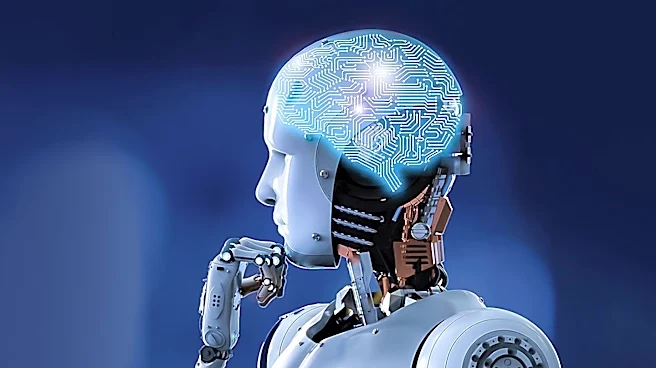
gaining prominence on the global stage. On the same day, Wang Xingxing, founder of Unitree Robotics, was featured on the cover of Time magazine with his humanoid robot, GD01. Additionally, Yang Zhilin, founder of Moonshot AI, has made significant waves in Western tech circles with his AI innovations. These developments underscore the increasing presence of Chinese talent in cutting-edge scientific fields, including mathematics, AI, and robotics.
Why It's Important?
The achievements of these Chinese scientists and entrepreneurs signify a shift in the global scientific landscape, with China emerging as a major player in technological innovation. This trend is supported by decades of investment in education and research infrastructure in China, which has enabled a new generation of scientists to compete on the world stage. The rise of Chinese talent in fields like AI and robotics could have significant implications for global tech industries, potentially altering competitive dynamics and innovation trajectories. As China continues to foster an environment conducive to scientific exploration, it may increasingly influence global research priorities and collaborations.
What's Next?
The continued success of Chinese scientists and innovators is likely to encourage further investment in education and research within China. This could lead to more international collaborations and exchanges, as well as increased participation in global scientific forums. However, geopolitical tensions and policies that restrict academic exchanges could pose challenges to this trend. The global scientific community may need to navigate these complexities to maintain open and productive collaborations. As China solidifies its role in global science and technology, other nations may need to adapt their strategies to remain competitive.
Beyond the Headlines
The rise of Chinese scientific talent also raises questions about the future of global scientific leadership and the role of international collaboration in driving innovation. The experiences of Wang and Deng highlight the importance of open and collaborative research environments. As China becomes more integrated into the global scientific community, it may challenge existing paradigms and encourage a more inclusive approach to scientific discovery. This could lead to a more diverse and interconnected global research ecosystem, benefiting from a wider range of perspectives and expertise.