
What's Happening?
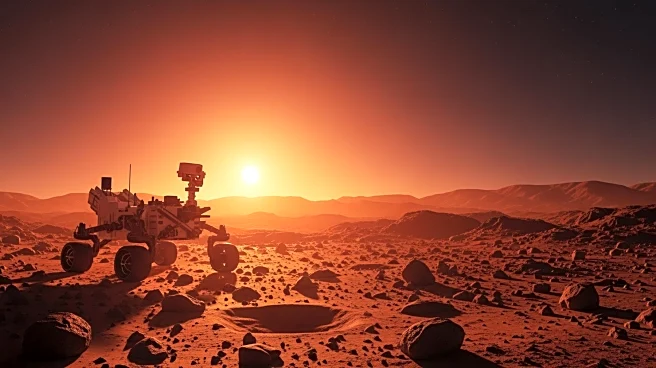
On January 25, 2004, NASA's Opportunity rover successfully landed on Mars, marking a significant achievement in space exploration. The landing, described by NASA as the 'six minutes of terror,' involved
a complex descent using a parachute and retrorockets to slow down from a speed of 11,800 mph. The rover was encased in airbags to cushion its impact, allowing it to bounce 26 times before coming to rest inside Eagle Crater. This location was fortuitous, as it was surrounded by several scientific targets, enabling Opportunity to begin its mission immediately. Over the next 15 years, Opportunity explored more than 28 miles of the Martian surface, conducting valuable scientific research until a severe dust storm in June 2018 ended its mission.
Why It's Important?
The successful landing and extended mission of the Opportunity rover represent a major milestone in the field of space exploration. Opportunity's findings have contributed significantly to our understanding of Mars, providing insights into the planet's geology and past environmental conditions. The rover's ability to operate for 15 years, far exceeding its expected lifespan, demonstrates the durability and effectiveness of NASA's engineering and planning. This mission has paved the way for future Mars exploration, influencing the design and objectives of subsequent missions, including the ongoing Mars 2020 Perseverance rover mission. The data collected by Opportunity continues to inform scientific research and inspire future exploration efforts.
What's Next?
While Opportunity's mission has concluded, its legacy continues to influence current and future Mars exploration missions. NASA's Perseverance rover, which landed on Mars in February 2021, builds on the foundation laid by Opportunity, focusing on astrobiology and the search for signs of ancient microbial life. The success of Opportunity has also bolstered international interest in Mars exploration, with other countries planning their own missions to the Red Planet. As technology advances, the lessons learned from Opportunity will guide the development of more sophisticated rovers and potentially human missions to Mars, further expanding our understanding of the planet and the potential for life beyond Earth.
Beyond the Headlines
Opportunity's mission highlights the importance of international collaboration and public interest in space exploration. The rover's journey captured the imagination of people worldwide, fostering a sense of global unity and curiosity about the universe. The mission also underscores the challenges of operating in harsh extraterrestrial environments, prompting ongoing research into improving the resilience and capabilities of space exploration technologies. As space agencies continue to push the boundaries of exploration, Opportunity's story serves as a testament to human ingenuity and the enduring quest for knowledge.