

What's Happening?
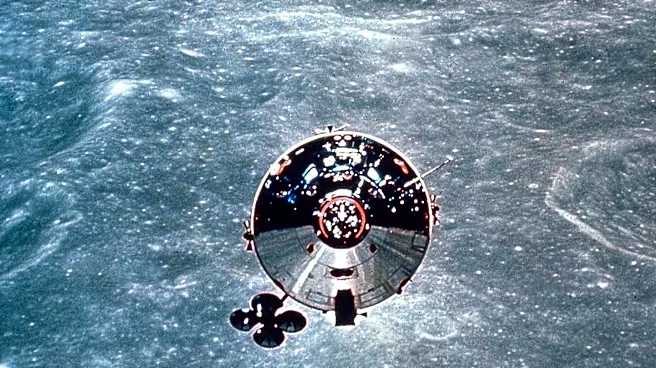
During the historic Apollo 11 mission in July 1969, while Neil Armstrong and Buzz Aldrin became the first humans to land on the Moon, astronaut Michael Collins remained in lunar orbit aboard the command module Columbia. Collins's primary task during this
phase was to pilot the Columbia, orbiting 60 nautical miles (112 kilometers) above the lunar surface. He had limited duties while Armstrong and Aldrin were on the Moon, but Houston Mission Control enlisted his help to locate the lunar module, Eagle, providing him with map coordinates. Despite his efforts using a navigational sextant, Collins was unable to thoroughly search the area or find the Eagle due to the rapid speed of Columbia's orbit over the landing site. The exact location of the Eagle was later determined through post-mission analysis of Armstrong's descriptions and the spacecraft's landing trajectory.
Why It's Important?
Michael Collins's role in the Apollo 11 mission, though often overshadowed by the lunar landing itself, was critical to the mission's success and safety. As the pilot of the command module, he was responsible for maintaining the orbital platform that would eventually rendezvous with the lunar module for the return journey to Earth. His solitary orbit underscored the immense distances and isolation involved in space travel, highlighting the precision and reliability required of both the astronauts and the spacecraft. Collins's inability to visually locate the Eagle from orbit, despite having map coordinates, illustrates the challenges of space navigation and observation, even with advanced technology of the era. This aspect of the mission emphasizes the meticulous planning and redundant systems necessary for human spaceflight, ensuring that even if one component of the mission faced difficulties, the overall objective could still be achieved.
What's Next?
While the Apollo 11 mission concluded successfully with the safe return of all three astronauts, the legacy of Michael Collins's role continues to be recognized in the context of human space exploration. His experience highlights the diverse and specialized roles required for complex space missions, from lunar surface operations to orbital mechanics. Future space missions, particularly those aiming for sustained lunar presence or Mars exploration, will continue to rely on similar divisions of labor and the critical importance of orbital support. The challenges faced by Collins in locating the lunar module from orbit also inform the development of advanced navigation and remote sensing technologies for current and future space endeavors, ensuring greater precision and situational awareness for astronauts and mission control.
Beyond the Headlines
Michael Collins's experience in lunar orbit during Apollo 11 offers a unique perspective on the human element of space exploration. His isolation, while his crewmates walked on the Moon, has often been described as one of the loneliest experiences in history. This aspect of the mission delves into the psychological and emotional dimensions of long-duration space travel and the profound sense of responsibility borne by astronauts. Beyond the technical achievements, Collins's story contributes to the broader narrative of human endeavor, sacrifice, and the pursuit of the unknown. It also serves as a reminder that even in missions with highly visible achievements, the less-publicized, yet equally vital, contributions of individuals are indispensable to overall success, shaping our understanding of teamwork and resilience in extreme environments.