









What's Happening?
A new policy paper highlights a significant concern regarding the proposed Global Plastics Treaty: the absence of reporting requirements. According to co-author Roland Geyer, a professor at the University of California, Santa Barbara, this omission would
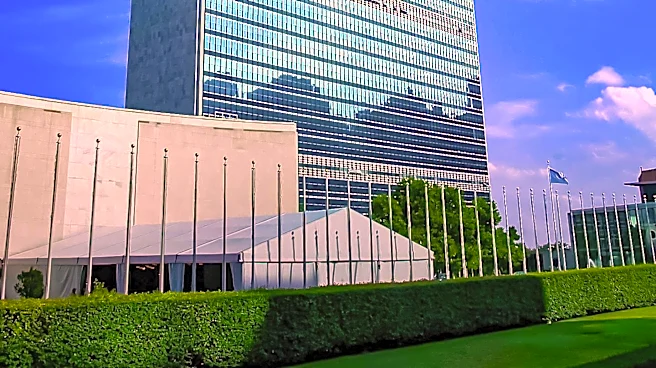
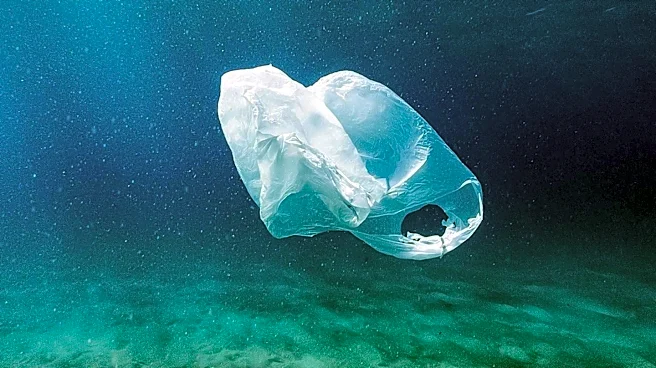
make it challenging to determine if new plastic regulations are effective. United Nations negotiations for a legally binding agreement on plastic pollution began in 2022, and after five sessions, no agreement has been reached, with another session planned for March 2027. The paper, co-authored by Quanyin Tan, an assistant professor at Tsinghua University, and Douglas McCauley, also a professor at the University of California, Santa Barbara, examines gaps in existing plastic data and proposes a shared reporting system. The authors emphasize that countries currently measure plastic production, use, trade, and disposal in different ways, making it difficult to compare data and assess the impact of new rules. For instance, some countries do not consistently count all materials as plastic, and synthetic fibers are often categorized under textiles instead of plastic. The proposed system would focus on four key areas for national reporting: plastic production and trade, chemical additives, plastic use in products, and waste management.
Why It's Important?
The lack of standardized reporting in a global plastics treaty has significant implications for the U.S. and the international community's efforts to combat plastic pollution. Without consistent data on plastic production, chemical composition, usage, and waste management, it will be nearly impossible to accurately measure the effectiveness of any new regulations. This could lead to inefficient policies, wasted resources, and continued environmental degradation. For U.S. industries, particularly those involved in plastics manufacturing, recycling, and waste management, a clear and consistent global framework is crucial for long-term planning and investment. The absence of such a framework creates uncertainty and could hinder the development of innovative solutions. Furthermore, the paper points out that companies often keep information about chemical additives confidential, making it difficult to assess health risks or determine if plastic waste is suitable for reuse or recycling. This lack of transparency poses potential health and environmental risks that could affect U.S. citizens and ecosystems. The public's growing concern about plastic pollution, as noted by Geyer, underscores the urgency of a robust and measurable global response.
What's Next?
The ongoing United Nations negotiations for a global plastics treaty, with another session scheduled for March 2027, will be a critical juncture for addressing the proposed reporting requirements. The authors of the policy paper advocate for the inclusion of a comprehensive reporting system, arguing that it is essential for understanding and managing plastic pollution effectively. Key stakeholders, including governments, industries, and environmental organizations, will likely continue to debate the scope and enforceability of such reporting. Financial support and capacity building will be crucial for countries with varying resources and data systems to implement any agreed-upon reporting framework. The outcome of these negotiations will determine whether the first version of the Global Plastics Treaty will include the necessary mechanisms to track progress and hold nations accountable. Without these measures, the treaty's ability to achieve its objectives of reducing plastic pollution and its associated impacts will be severely limited.
Beyond the Headlines
The debate over reporting requirements in the Global Plastics Treaty extends beyond mere data collection; it touches upon fundamental issues of transparency, accountability, and the global governance of environmental resources. The current inconsistencies in how countries measure plastic-related data highlight a broader challenge in international environmental agreements: the difficulty of establishing common standards and ensuring compliance across diverse national contexts. The paper's emphasis on tracking plastic from 'cradle to grave' underscores a shift towards a more holistic understanding of product lifecycles and their environmental impact. This approach could pave the way for future regulations that not only address waste but also influence product design, material selection, and industrial processes. The ethical dimension of chemical transparency is also significant, as the lack of information on hazardous additives can compromise public health and environmental safety. Ultimately, the success of a global plastics treaty hinges on its ability to foster a shared understanding of the problem and create a robust framework for collective action, moving beyond fragmented national efforts to a truly global solution.