





What's Happening?
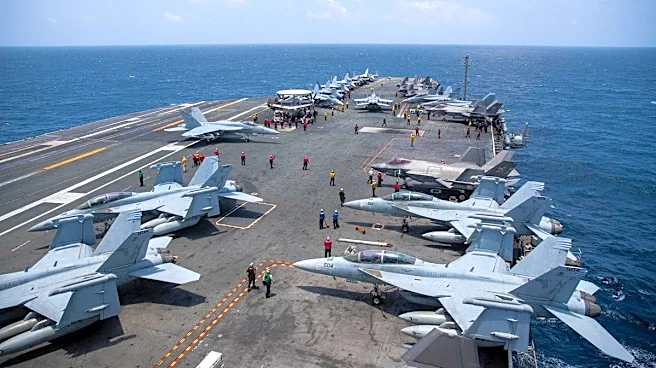
The U.S. House Armed Services Committee is investigating the diversion of sensitive F-35 Lightning II components to Hong Kong. These components, intended for repair in the United States, were rerouted while being transported from Australia across the Pacific.
The Pentagon’s F-35 Joint Program Office has acknowledged the incident and is working with U.S. authorities and industry partners to recover the equipment, determine how the diversion occurred, and implement measures to prevent future recurrences. While the precise contents of the shipment have not been officially disclosed, earlier reports suggest it included an F-35 cockpit canopy, which is particularly sensitive due to its role in the fighter's low-observable characteristics. This incident has transformed what might have been considered a logistics error into a significant security investigation concerning the movement of advanced military technology through the F-35’s global supply chain.
Why It's Important?
This incident raises critical questions about the integrity and security of the F-35's global logistics system, which is designed to move thousands of components rapidly worldwide. The potential exposure of sensitive F-35 technology, even from unserviceable components, could provide adversaries with valuable information about the aircraft's design, materials, and manufacturing techniques. This is particularly concerning given the F-35's advanced stealth capabilities, which rely on a complex interplay of geometry, radar-absorbent materials, and coatings. For the U.S. and its allies, including a growing number of European NATO members, the findings of this investigation will have significant implications for the wider security architecture surrounding the F-35 program. It highlights a potential vulnerability in the multinational supply system, which is a core operational advantage of the F-35 program but also creates multiple points of potential compromise.
What's Next?
Investigators will need to determine whether the diversion was the result of an administrative shipping error, contractor procedures, inadequate tracking, an intermediary's involvement, or deliberate action. The F-35 Joint Program Office and the House Armed Services Committee will continue their oversight work, aiming to establish accountability and implement corrective measures. This incident is likely to intensify scrutiny on the management of F-35 spare parts, an area where the U.S. Government Accountability Office (GAO) has previously identified weaknesses. The GAO found in 2023 that the Department of Defense did not adequately account for spare parts outside prime-contractor facilities and that significant losses of parts had occurred. Future actions will likely focus on strengthening controls, improving inventory accuracy, and ensuring that government property is not distributed without proper authorization, to prevent similar security breaches in the future.
Beyond the Headlines
The F-35 parts diversion underscores a broader challenge in managing complex, multinational defense programs. While the global F-35 fleet, now almost 1,300 aircraft strong, benefits from shared logistics and a common supply network, this interconnectedness also creates inherent security risks. The incident highlights the tension between operational efficiency and the need for stringent security protocols in a globalized defense industrial base. It also brings to light the ethical and legal dimensions of technology transfer and protection, especially when dealing with advanced military capabilities. The potential for reverse-engineering or intelligence gathering from seemingly innocuous components could have long-term strategic implications, influencing how the U.S. and its allies manage sensitive technology in future collaborations and sales, such as the proposed sale of F-35As to Saudi Arabia. This event could trigger a re-evaluation of supply chain security practices across the entire defense industry.