
What's Happening?
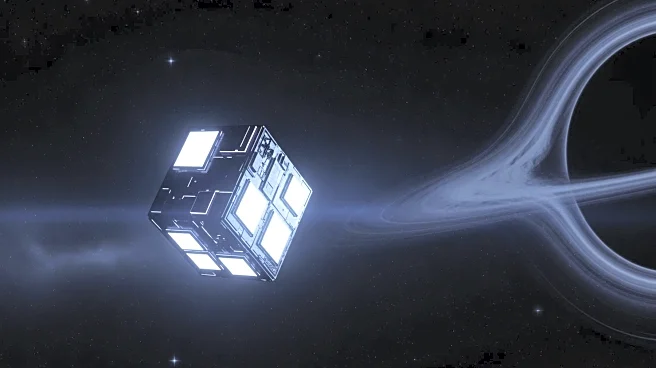
SpaceX's recent launch from Vandenberg Space Force Base included two CubeSats, SPARCS and BlackCAT, designed to study low-mass stars and black holes. These small satellites were part of a rideshare mission,
which also included NASA's Pandora satellite. SPARCS, developed by Arizona State University and NASA's Jet Propulsion Laboratory, will monitor ultraviolet emissions from low-mass stars to understand their impact on surrounding environments. BlackCAT, from Pennsylvania State University, will conduct a wide-field X-ray survey to detect transient events like gamma-ray bursts. These missions aim to enhance our understanding of stellar activity and the early universe.
Why It's Important?
The deployment of SPARCS and BlackCAT represents a significant advancement in space research, particularly in the study of stellar and black hole phenomena. By focusing on low-mass stars, SPARCS will provide valuable data on how these stars affect their planetary systems, which is crucial for assessing the habitability of exoplanets. BlackCAT's exploration of gamma-ray bursts and black holes will contribute to our understanding of the universe's evolution and the life cycles of massive stars. These missions highlight the growing role of CubeSats in space exploration, offering cost-effective means to conduct sophisticated scientific research.