





What's Happening?
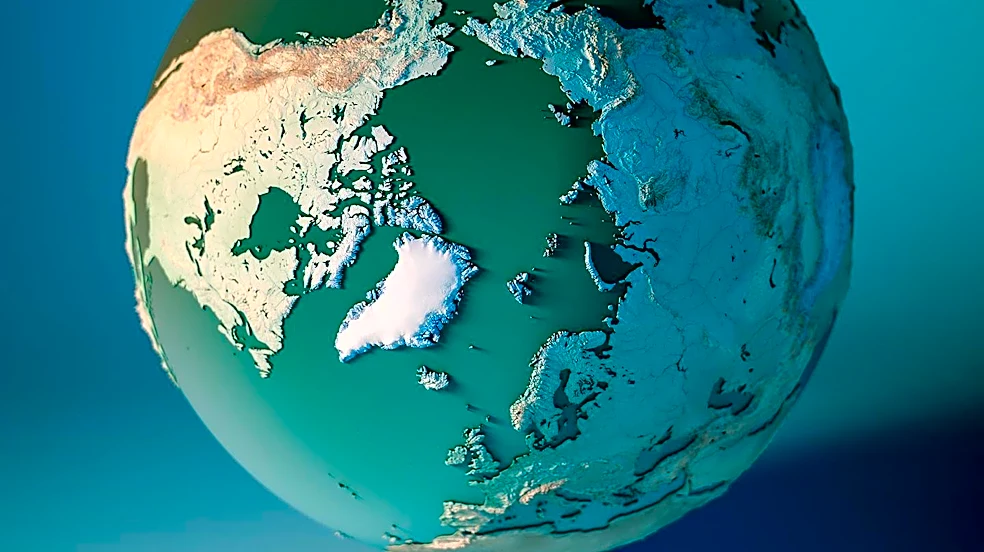
New research led by Dr. Jordan Phethean at the University of Derby is challenging the conventional understanding of Earth's seven continents, suggesting that Europe and North America may not be as separated as traditionally believed. The study focuses
on the North Atlantic, where the North American and Eurasian tectonic plates are slowly diverging. Contrary to the long-held belief that these plates fully broke apart 52 million years ago, the researchers propose that geological material from both continents may still be connected beneath the ocean. This theory is supported by findings in Iceland and the Davis Strait, where unusually thick crust and specific geological formations suggest remnants of continental material rather than purely oceanic crust. The research, published in Gondwana Research, uses gravity measurements, seismic reflection data, and crustal thickness maps to reconstruct the region's geological history.
Why It's Important?
This research has significant implications for how scientists define and map Earth's continents, potentially leading to a re-evaluation of geological models. A revised understanding of continental boundaries could improve the accuracy of ancient ocean reconstructions, enhance interpretations of past climate changes, and refine assessments of earthquake hazards along former plate boundaries. For industries, this could influence the search for mineral resources, as different types of crust (continental versus volcanic) host distinct mineral deposits. The study also highlights the complex and non-uniform nature of continental breakup, suggesting that the process can involve stretching and shifting without always forming a typical ocean basin. This challenges fundamental assumptions in geology and plate tectonics, impacting academic and scientific communities globally.
What's Next?
The researchers plan further investigations to validate their findings, including analyzing Iceland's volcanic rocks, running advanced computer simulations, and refining existing plate-tectonic models. These steps are crucial to determine definitively whether continental fragments persist beneath lava-rich regions in the North Atlantic. If confirmed, this research could lead to a broader re-evaluation of continental definitions and geological mapping worldwide. The scientific community will likely engage in extensive debate and further studies to either corroborate or refute these claims, potentially reshaping geological textbooks and scientific consensus on Earth's continental structure. This ongoing scientific inquiry will continue to push the boundaries of our understanding of planetary geology.
Beyond the Headlines
The re-evaluation of continental boundaries touches upon profound philosophical and cultural implications regarding how humanity perceives and categorizes the world. The idea of a fluid, rather than fixed, continental structure challenges the very maps that have shaped geopolitical and cultural identities for centuries. This scientific shift could subtly influence educational curricula, public understanding of geology, and even long-term discussions about resource allocation and territorial claims, particularly in areas where continental shelves are ambiguously defined. It underscores the dynamic nature of scientific knowledge and how even seemingly settled facts can be overturned by new evidence, fostering a deeper appreciation for the ongoing process of discovery and the ever-evolving understanding of our planet.