




What's Happening?
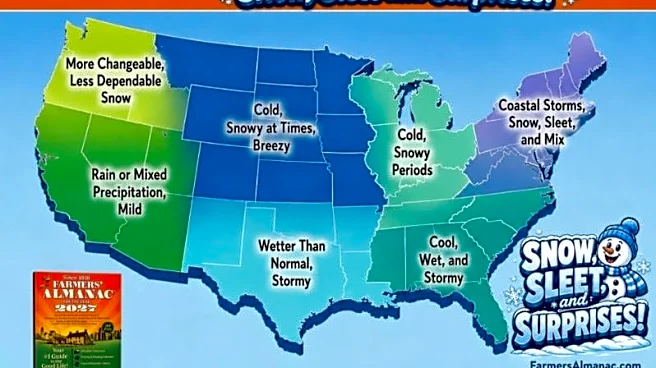
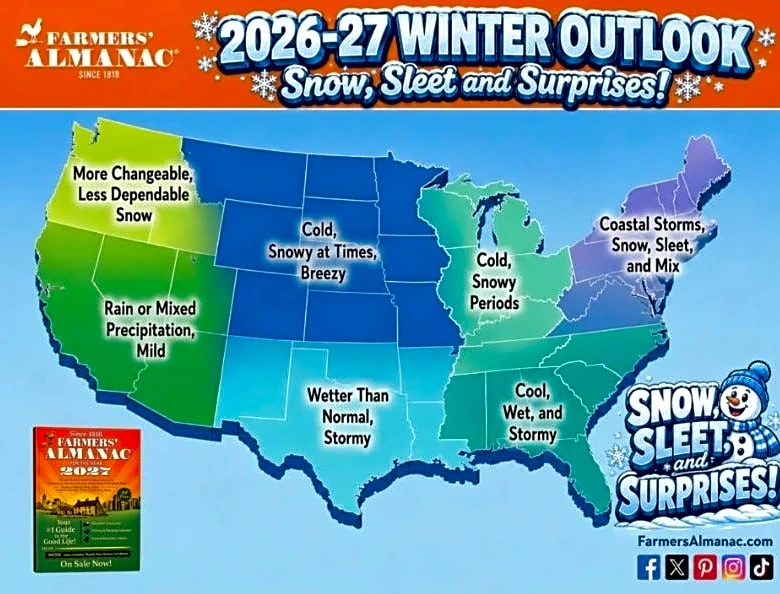
The Old Farmer's Almanac has released its winter outlook for 2025, predicting an average to mild winter across most of the United States. Temperatures are generally expected to be warmer than normal, while precipitation is anticipated to be above normal in large
parts of the West and sections of the South, Midwest, and Florida. However, regions that experienced severe winter storms in January could still face colder-than-usual weather, specifically in the Ohio Valley, parts of Appalachia, and the southern Northeast. Higher-than-usual snowfall is also projected for parts of the Northeast, Appalachia, some areas of the West, and Alaska. Conversely, drier conditions are expected for much of the East, the Plains, and the Southwest. The Almanac, which claims over 80% accuracy in its previous year's predictions, uses a secret formula devised in 1792, updated with modern technology and scientific calculations, comparing solar patterns and historical weather conditions with solar activity.
Why It's Important?
This forecast holds significant importance for various sectors across the U.S. A mild winter could lead to reduced heating costs for households and businesses, potentially boosting consumer spending in other areas. For the agricultural sector, the predicted dry winter patterns in key farming regions, as seen in 2024, could exacerbate stress on crops and water supplies, impacting yields and food prices. Conversely, increased precipitation in the West could help alleviate ongoing drought concerns. The forecast also has implications for infrastructure and emergency services, as wetter conditions increase the risk of flooding and potential power outages, while higher snowfall in specific areas necessitates preparedness for travel disruptions and increased cleanup costs. The varying regional predictions highlight the need for localized planning and resource allocation to mitigate potential negative impacts and capitalize on favorable conditions.
What's Next?
As the winter season approaches, ongoing updates and specific regional forecasts will become crucial for decision-making. Individuals and communities in areas expecting wetter conditions should focus on clearing drains and identifying flood-prone spots to minimize damage. For drivers in areas anticipating more snow, checking vehicle maintenance, such as tires, wipers, and batteries, is advised. Homeowners are encouraged to prepare by checking furnaces, sealing drafty windows and doors, and stocking emergency kits with essentials like flashlights, batteries, water, and medications. The influence of El Niño on the polar vortex remains a key factor that forecasters are monitoring, as it could significantly alter weather patterns and bring frigid Arctic air further south. While some meteorologists express skepticism about almanac-style forecasting, the general outlook provides an early alert for potential weather trends, prompting proactive measures.
Beyond the Headlines
The Old Farmer's Almanac's continued relevance in an era of advanced meteorological science highlights a cultural reliance on traditional forecasting methods, even as modern scientific models become more sophisticated. The blend of historical data and 'state-of-the-art technology' in their methodology reflects an attempt to bridge traditional wisdom with contemporary tools. The skepticism from some meteorologists, who advocate for more immediate and detailed forecasts, underscores the ongoing debate between long-range predictive models and short-term accuracy. This dynamic also touches upon public trust in different sources of information regarding climate and weather, influencing how individuals and institutions prepare for seasonal changes. The potential for even a 'mild' winter to bring significant problems, such as brief cold snaps increasing heating costs or wet storm systems causing travel interruptions, emphasizes the complex and often unpredictable nature of weather, regardless of initial forecasts.