

What's Happening?
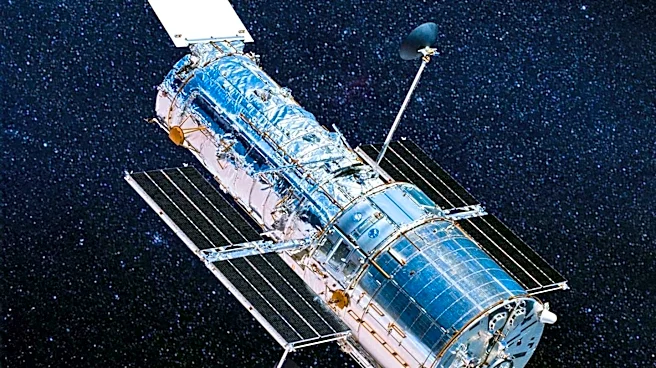
Katalyst Space's LINK spacecraft, designed to save NASA's Neil Gehrels Swift Observatory, has regained control after a software update corrected a tumbling issue. The spacecraft, launched to boost the Swift telescope's orbit, faced challenges when it began
spinning uncontrollably. Engineers have stabilized the spacecraft, allowing the mission to proceed with plans to elevate the telescope's orbit from 350 kilometers back to its original 600 kilometers. This effort aims to extend the operational life of the Swift telescope, which is crucial for studying gamma-ray bursts and other cosmic phenomena.
Why It's Important?
The Swift telescope is a vital tool for astrophysical research, providing unique capabilities to observe transient cosmic events. Its ability to quickly reposition and capture data on gamma-ray bursts makes it indispensable for understanding these high-energy phenomena. The successful stabilization of the LINK spacecraft is crucial for preventing the premature decommissioning of the Swift telescope, ensuring continued contributions to space science. The mission highlights the importance of innovative solutions in extending the life of valuable scientific instruments.
What's Next?
Katalyst Space will continue to perform orbital adjustments to align LINK with the Swift telescope, preparing for the boost operation. The mission's success depends on precise maneuvers to dock with the telescope and gradually raise its orbit. If successful, the telescope's operational life could be extended by several years, allowing for continued scientific discoveries. The mission underscores the potential for future satellite servicing missions to extend the life of space-based assets.