






What's Happening?
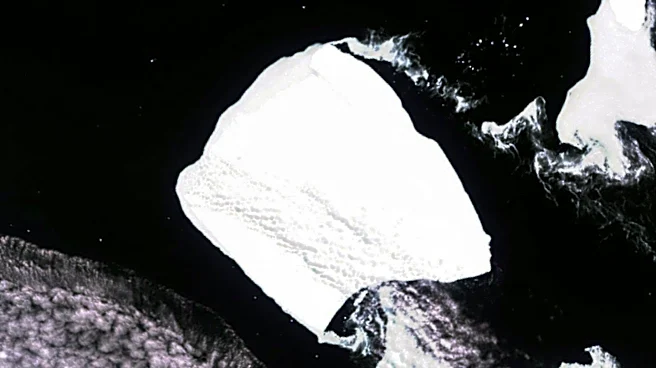
NASA's latest satellite images, captured by the Operational Land Imager on Landsat 9, show Vega Island in Antarctica resembling a grinning skull. This striking visual, published on October 30, 2026, highlights unusually large areas of bare ice. A rocky
peak forms the eye socket, a lateral moraine creates a mouth, and Devil’s Bay Glacier forms the jawbone. The comparison with an image from March 22, 2025, reveals a significant reduction in snow cover, exposing darker bare ice. Glaciologist Mauri Pelto of Nichols College attributes this to above-average temperatures during the 2026 winter, particularly in June, and limited new snow accumulation. This phenomenon is part of a longer pattern of change observed on the Antarctic Peninsula, where warming conditions and reduced snow are altering the landscape.
Why It's Important?
The increased exposure of bare ice on Vega Island is a critical indicator of climate change impacts in Antarctica. Bare ice is darker than snow, causing it to absorb more solar radiation, which accelerates melting. This creates a feedback loop where exposed ice warms faster and loses mass more quickly. This accelerated melting contributes to global sea-level rise, posing long-term threats to coastal communities and ecosystems worldwide. The phenomenon also affects local Antarctic ecosystems, impacting species reliant on stable ice environments. The visual representation of the 'skull' serves as a powerful, albeit stark, reminder of the ongoing environmental shifts and the urgency of addressing climate change.
What's Next?
If the ice on Vega Island remains exposed, the skull-like features are expected to gradually change as the ice weathers away, leading to a 'changing jawline and expanding eye socket,' according to Glaciologist Mauri Pelto. Scientists will continue to monitor Vega Island and other Antarctic glaciers using satellite imagery to track snow cover, glacier extent, and exposed rock. This ongoing data collection is crucial for understanding the rate and extent of ice loss and for refining climate models. The findings will inform international discussions and policy decisions regarding climate change mitigation and adaptation strategies, particularly concerning sea-level rise projections.
Beyond the Headlines
The 'skull-like' appearance of Vega Island, while a natural formation, carries a symbolic weight in the context of climate change. It serves as a visual metaphor for the planet's vulnerability and the potential consequences of environmental degradation. This imagery can resonate deeply with the public, fostering greater awareness and engagement with climate science. Historically, Vega Island has a dramatic past, including a Swedish Antarctic Expedition in the early 1900s where explorers were stranded. The current satellite images connect this historical narrative of human struggle against nature with the contemporary challenge of climate change, highlighting how natural landscapes are continuously shaped by both geological processes and climatic shifts.