





What's Happening?
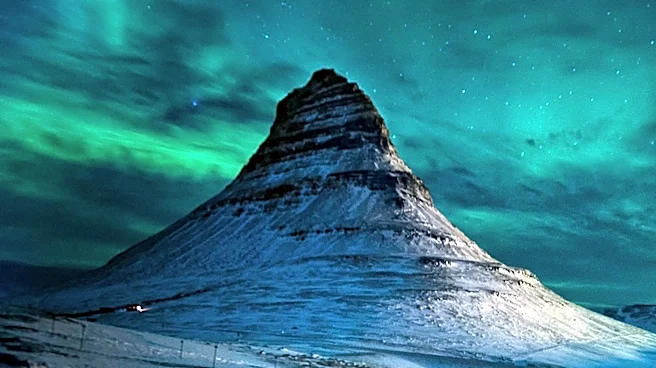
A photograph taken from Kvaløya, an island in northern Norway, featured in NASA’s Astronomy Picture of the Day, displays two prominent arches of light: the Milky Way and an auroral ribbon. Despite their apparent proximity in the image, NASA explains that
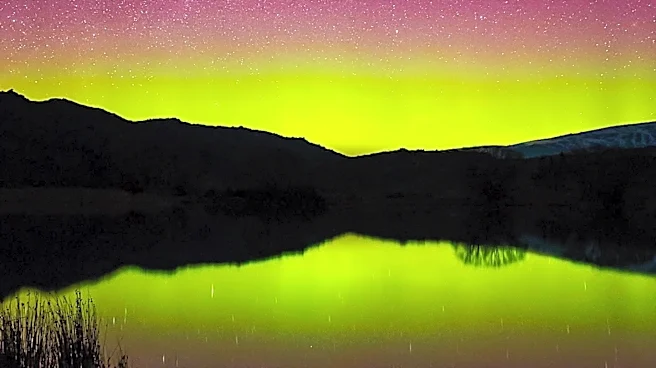
these two luminous formations have vastly different origins and physical characteristics. The textured arch on the left is a segment of the Milky Way galaxy, an ancient astronomical structure composed of stars, gas, and dust that existed long before Earth. In contrast, the smoother arch on the right is an auroral ribbon, a temporary atmospheric phenomenon formed by energized atoms and molecules in Earth’s upper atmosphere, which was only hours old when photographed. The Milky Way's visible structure is part of a distant astronomical environment, while the aurora occurs close to Earth within its atmosphere. Their simultaneous appearance in the photograph is a temporary alignment, not a physical encounter.
Why It's Important?
This NASA-featured image is significant for its ability to visually articulate complex astronomical and atmospheric concepts to the public. By showcasing two vastly different celestial phenomena side-by-side, it highlights the immense scale and diverse processes at play in the universe and within Earth's immediate environment. The photograph serves as an educational tool, illustrating the distinction between galactic structures and atmospheric events, and emphasizing that apparent proximity in a visual frame does not equate to physical closeness. It also underscores the Sun's dual role as a component of the Milky Way and as the source of energetic particles that create auroras, thereby connecting phenomena across vastly different scales of time and distance. This visual comparison can deepen public understanding of space and atmospheric science.
What's Next?
NASA and other space agencies will continue to capture and share images that illustrate complex scientific principles, using platforms like Astronomy Picture of the Day to engage and educate the public. Future observations and analyses will further refine our understanding of both galactic structures and auroral dynamics. Scientists will continue to study solar activity and its impact on Earth's magnetosphere, which directly influences auroral displays. Advances in imaging technology will likely provide even more detailed and stunning views of these phenomena, potentially revealing new insights into their formation and evolution. Educational outreach efforts will continue to leverage such captivating imagery to inspire interest in science and astronomy.
Beyond the Headlines
The photograph transcends a mere scientific illustration; it evokes a sense of wonder and humility by juxtaposing the ancient, vast expanse of our galaxy with the fleeting, localized beauty of an aurora. This visual narrative encourages contemplation on humanity's place within the cosmos, highlighting the transient nature of earthly phenomena against the backdrop of cosmic immensity. Ethically, it reinforces the value of scientific observation and documentation in preserving and sharing the beauty of the natural world, both terrestrial and extraterrestrial. Culturally, such images contribute to a shared human experience of awe and curiosity about the universe, bridging scientific understanding with artistic appreciation and inspiring future generations of scientists and explorers.