







What's Happening?
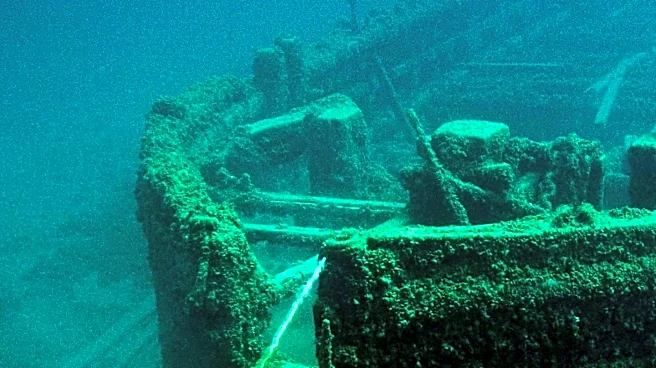
The wreckage of the SS Cornwallis, a Canadian steamship torpedoed by a German U-boat in 1944, has been discovered off the coast of Mount Desert Island, Maine. A self-funded group of New England divers, the Nomad Exploration Team, located the vessel in July,
nearly 400 feet below the ocean's surface, after seven years of searching. The SS Cornwallis, a 400-foot merchant ship carrying sugar and molasses, sank in just 10 minutes on December 3, 1944, killing 43 of the 48 people on board. This sinking occurred just four days after the same German U-boat, U-1230, had covertly landed two Nazi spies, Erich Gimpel and William Colepaugh, near Hancock, Maine. The discovery provides closure for the families of the victims and highlights the proximity of World War II to the U.S. coastline. The ship had previously been torpedoed and damaged in Barbados in 1942 but was repaired and returned to service.
Why It's Important?
The discovery of the SS Cornwallis wreckage is significant for several reasons. It brings to light a largely forgotten tragedy of World War II, offering a tangible connection to the sacrifices made during the Battle of the Atlantic. For the families of the 43 crew members who perished, many of whom were Canadian, the finding provides a final resting place and a sense of closure after more than 80 years. The event also underscores the direct impact of the war on U.S. shores, as the U-boat responsible for the sinking had just deployed Nazi saboteurs on American soil. This historical context reminds the public of the real and present danger the U.S. faced during the war, extending beyond distant battlefields. The efforts of volunteer dive teams like the Nomad Exploration Team are crucial in preserving maritime history and honoring those lost at sea.
What's Next?
The Nomad Exploration Team plans to continue documenting various parts of the shipwreck. Their immediate goals include deploying a remotely operated vehicle (ROV) to the site by next year to further explore and record the vessel. Dive team member Danny Allan has expressed a personal goal of recovering a small artifact from the wreck to present to the victims' families, though he acknowledges the difficulty of such a task given the ship's depth. The team does not intend to claim ownership of the wreck, which lies in federal waters, but rather aims to provide historical context and closure. The discovery is expected to renew interest in World War II maritime history along the Maine coast and potentially inspire further research into other undiscovered shipwrecks in the region.
Beyond the Headlines
The discovery of the SS Cornwallis wreckage transcends a simple historical find; it serves as a poignant reminder of the human cost of war and the often-overlooked contributions of merchant mariners. The ship's story, intertwined with the clandestine landing of Nazi spies on U.S. soil, illustrates the complex and far-reaching nature of global conflicts. It highlights the vulnerability of coastal communities and the constant threat faced by those transporting vital supplies during wartime. Ethically, the divers' respectful approach to the wreck as a grave site, rather than a treasure trove, sets an important precedent for future underwater explorations. This event also underscores the enduring power of citizen-led initiatives in historical preservation, demonstrating how dedicated individuals can contribute significantly to our understanding of the past and honor forgotten narratives.