





What's Happening?
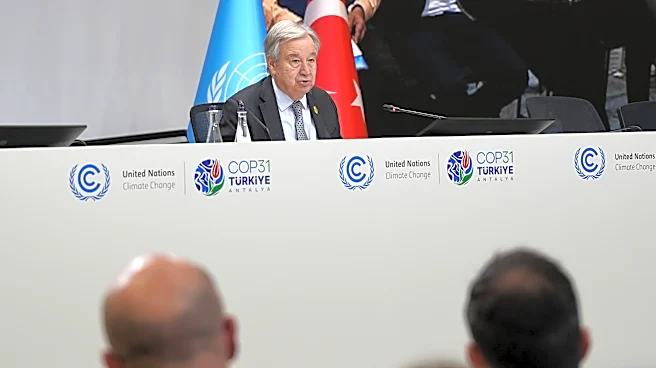
Turkish Energy and Natural Resources Minister Alparslan Bayraktar has called for consistent government policies to support international green transition efforts, speaking at the 31st United Nations Climate Change Conference (COP31) in Antalya, Türkiye.
Bayraktar emphasized that fluctuating policies, strategies, and visions across different administrations are significant obstacles to global climate action. He highlighted China's advancements in reducing carbon emissions, promoting green technology innovation, and enhancing renewable energy competitiveness, expressing Türkiye's interest in deepening its clean energy partnership with China. Bayraktar noted that Chinese companies and technology providers could offer crucial support for Türkiye's energy transformation across various sectors, including nuclear, grid, renewable energy, and battery solutions. The COP31 conference, running from November 15 to November 20, aims to accelerate global climate action, foster green cooperation, and advance the implementation of the Paris Agreement.
Why It's Important?
The call for policy stability by a key energy minister underscores a critical challenge in global climate efforts: the need for long-term, consistent governmental approaches to facilitate the transition to clean energy. Inconsistent policies can deter investment, slow technological adoption, and create uncertainty for businesses and international collaborations. This is particularly relevant for the U.S. as it navigates its own clean energy transition, where shifts in federal and state policies can impact domestic and international partnerships. The emphasis on China's role in green technology also highlights its growing influence in the global clean energy landscape, presenting both opportunities for collaboration and potential competitive pressures for U.S. industries. For the U.S., ensuring policy predictability could enhance its leadership in climate action and attract necessary investments in renewable energy infrastructure and innovation.
What's Next?
The ongoing COP31 conference will continue to facilitate discussions among international delegates, climate experts, and stakeholders, aiming to identify pathways for enhanced global climate action and green cooperation. The emphasis on policy consistency suggests that future international climate agreements and bilateral partnerships, including those involving the U.S., may increasingly prioritize mechanisms to ensure long-term policy commitments. Türkiye's expressed interest in deeper collaboration with China on clean energy could lead to new joint ventures and technology transfers, potentially influencing global supply chains and market dynamics for renewable energy solutions. The outcomes of COP31 are expected to shape national climate strategies and international investment flows in the coming years, with a focus on translating commitments into tangible actions and stable policy frameworks.
Beyond the Headlines
Beyond the immediate policy discussions, the Turkish minister's remarks touch upon the broader geopolitical implications of the clean energy transition. The shift from fossil fuels to renewable energy sources can redistribute wealth and political power globally, as noted by Bill McKibben. Countries that lead in green technology and consistent policy implementation are likely to gain significant economic and diplomatic advantages. For the U.S., this means that its approach to clean energy is not just an environmental issue but also a matter of national security and economic competitiveness. The ability to foster stable domestic policies and engage in reliable international partnerships will be crucial for maintaining influence and ensuring a smooth, equitable global energy transition. The ethical dimension also arises, as the stability of policies directly impacts the effectiveness of climate action and the protection of vulnerable populations from climate change impacts.