



What's Happening?
Archaeologists have uncovered evidence of Paleo-Inuit dwellings on the remote islands of Kitsissut, located off the northwest coast of Greenland. This discovery, detailed in a study published in the journal Antiquity, reveals that these early Arctic people
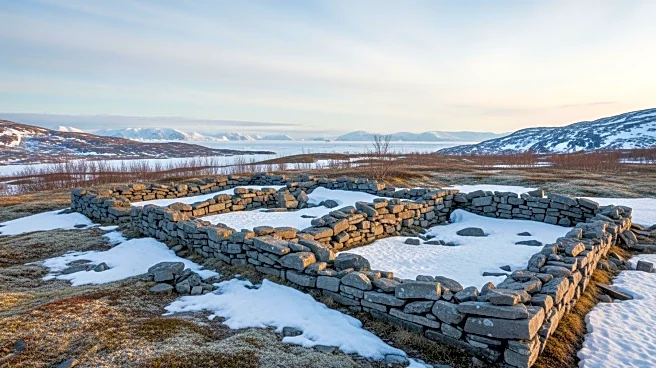
reached the islands nearly 4,500 years ago. The islands, known for their rich marine environment, were accessed by the Paleo-Inuit using advanced watercraft technology and seafaring skills. The archaeological survey identified nearly 300 features, including 15 dwellings on Isbjørne Island, suggesting repeated visits to the islands. The dwellings were marked by stone rings indicating tent structures, with a hearth at the center. The presence of animal bones dated the occupation to around 4,000 to 4,475 years ago. The journey to Kitsissut, a 33-mile trek through challenging sea conditions, highlights the Paleo-Inuit's maritime capabilities.
Why It's Important?
This discovery sheds light on the advanced maritime skills of the Paleo-Inuit people, emphasizing their ability to navigate and survive in harsh Arctic conditions. The findings challenge previous archaeological perspectives that viewed the region primarily as a transit route between Canada and Greenland. Instead, Kitsissut is now seen as a site of innovation and sustained human activity. The study provides insights into the social and cultural practices of the Paleo-Inuit, including their community-based approach to hunting and resource gathering. This research contributes to a broader understanding of human adaptation and resilience in extreme environments, offering valuable lessons for contemporary discussions on climate change and human survival.
What's Next?
Further archaeological excavations are anticipated to provide a more comprehensive understanding of the community life of the Paleo-Inuit on Kitsissut. Researchers aim to explore the extent of the community's activities and their interactions with the environment. These future studies could reveal more about the social structures and technological innovations of the Paleo-Inuit, enhancing our knowledge of early human societies in the Arctic. Additionally, the findings may prompt a reevaluation of other Arctic sites, potentially uncovering new evidence of prehistoric human activity in the region.
Beyond the Headlines
The discovery of the Paleo-Inuit dwellings on Kitsissut highlights the importance of interdisciplinary research in archaeology, combining historical, environmental, and technological perspectives. It underscores the role of indigenous knowledge in guiding archaeological investigations, as contemporary Inuit identified the islands as significant hunting grounds. This collaboration between scientists and indigenous communities can lead to more nuanced interpretations of archaeological findings, fostering a deeper appreciation of cultural heritage and its relevance to modern society.