
What's Happening?
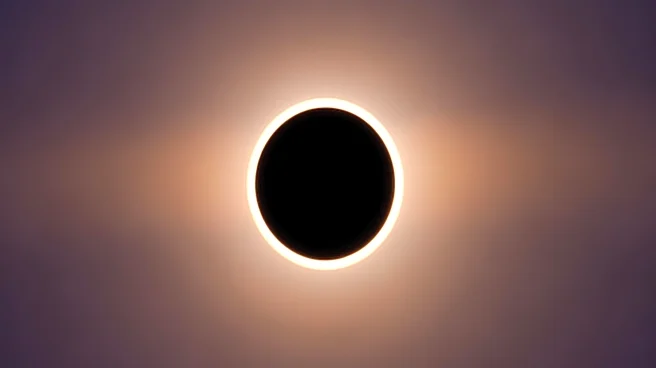
A total solar eclipse is set to occur on August 12, marking the first such event in over two years. This celestial phenomenon happens when the moon passes between the sun and Earth, casting a shadow that
fully blocks the sun's light in certain areas. The path of totality will span 5,157 miles, starting over the Arctic coastline and passing near the North Pole before moving over Greenland, Iceland, Portugal, and northern Spain. While a total eclipse will be visible in these regions, a partial eclipse can be observed across parts of Europe, Africa, and North America. The event is significant as it offers a rare opportunity for scientists to study the sun's corona and for citizen scientists to engage in atmospheric experiments.
Why It's Important?
The upcoming solar eclipse presents a valuable opportunity for scientific research and public engagement. Scientists plan to launch high-altitude balloons to capture images and data, aiming to replicate a historic 1919 experiment that confirmed Einstein's theory of general relativity. This event not only advances scientific understanding but also fosters public interest in space science. The eclipse serves as a reminder of humanity's shared curiosity and the potential for collaborative discovery. For the U.S., although not in the path of totality, the event highlights the importance of global scientific cooperation and public education in astronomy.
What's Next?
Following the August eclipse, the next total solar eclipse will occur on August 2, 2027, visible from southern Spain, North Africa, Saudi Arabia, and Yemen. The United States will not experience another total solar eclipse until March 30, 2033, with visibility limited to Alaska. A more widespread opportunity will arise on August 22, 2044, when a total eclipse will be visible from North Dakota and Montana. These future events will continue to provide opportunities for scientific study and public engagement, emphasizing the need for ongoing investment in space science and education.