
What's Happening?
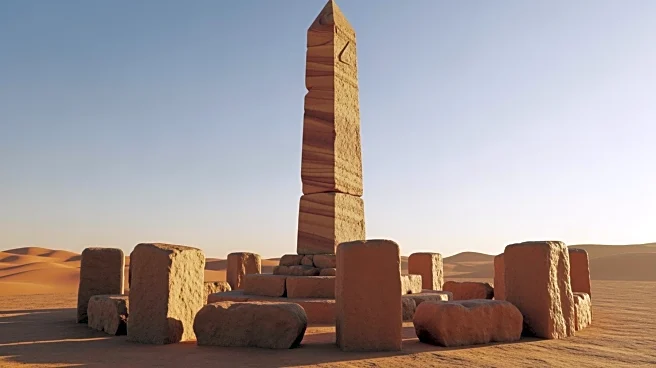
An Italian archaeological mission has discovered the remains of a sun temple dedicated to the sun god Ra, belonging to King Nyuserre of the Fifth Dynasty, near Cairo, Egypt. The temple, located in the Abusir
necropolis, is part of a monumental complex and is one of the few solar temples identified to date. The site was initially identified in 1901, but excavation was hindered by a high water table. Recent efforts have uncovered more than half of the temple, revealing a colossal structure with unique architecture. The discovery includes column bases, wall coverings, and a sloping ramp likely connecting the temple to the Nile. This find provides new insights into the religious and architectural practices of ancient Egypt during the Fifth Dynasty.
Why It's Important?
The discovery of the sun temple offers valuable insights into the religious and cultural practices of ancient Egypt, particularly during the Fifth Dynasty. It highlights the significance of solar worship and the architectural advancements of the period. The temple's unique features and its connection to the Nile suggest a sophisticated understanding of engineering and religious symbolism. This find contributes to the broader understanding of ancient Egyptian civilization and its influence on subsequent cultures. It also underscores the importance of archaeological research in uncovering historical narratives and preserving cultural heritage.
What's Next?
Further excavation and research are expected to continue at the Abusir necropolis to uncover more details about the sun temple and its role in ancient Egyptian society. Archaeologists may focus on understanding the temple's construction techniques and its significance within the context of the Fifth Dynasty. The findings could lead to a reevaluation of existing historical records and prompt new interpretations of ancient Egyptian religious practices. Additionally, the discovery may inspire similar archaeological missions to explore other potential sites of historical importance in Egypt.