




What's Happening?
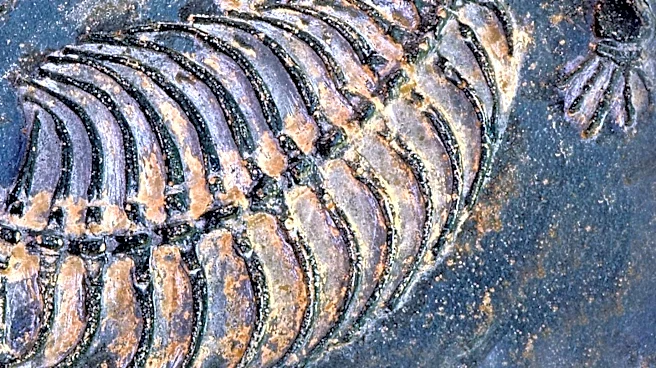
Researchers have discovered several 518-million-year-old fossils in south-western China, identified as Yujingia glutenotunica. These fossils are believed to be close to the last common ancestor of ambulacrarians, a group that includes modern starfish,
sea urchins, and acorn worms. The discovery challenges previous assumptions about how these early animals fed, suggesting they used tentacles to capture organic particles from the water rather than passively filtering with gills. The Yujingia fossils, ranging from eight to 22 millimeters in length, preserve the body, gut, and appendages, offering rare insights into soft-bodied creatures from the Cambrian explosion. This period was marked by rapid evolutionary development where most major animal groups first appeared in the fossil record. The unique preservation conditions in locations like the Maotianshan Shales in China's Yunnan Province allowed for the fossilization of these softer body parts, which typically decay.
Why It's Important?
This discovery is crucial for understanding the early animal tree of life and the evolutionary paths of major animal groups. It provides a missing link in the evolutionary history of ambulacrarians, suggesting a different feeding mechanism for their common ancestor than previously theorized. The find helps explain how two closely related lineages—starfish and their relatives, and chordates (which include humans)—evolved dramatically different body plans over millions of years. By offering rare examples of ambulacrarians without a mineralized skeleton, the fossils reveal that these animals possessed two distinct sets of appendages: feather-like feeding tentacles and a second set for temporary anchorage to the seabed. This challenges the notion that the last common ancestor of ambulacrarians resembled a worm filtering food from the seafloor, instead proposing a tentacle-feeding ancestor more akin to starfish.
What's Next?
The ongoing study of Yujingia glutenotunica and similar Cambrian fossils will continue to refine our understanding of early animal evolution. Researchers will likely further analyze the preserved structures to gain more detailed insights into the physiology and behavior of these ancient creatures. This discovery may prompt a re-evaluation of existing evolutionary models for deuterostomes, the broader group that includes both ambulacrarians and chordates. Future expeditions to sites with exceptional fossil preservation, such as the Maotianshan Shales, could uncover more transitional forms, further illuminating the origins and diversification of animal life during the Cambrian explosion. The findings will also contribute to broader discussions within paleontology and evolutionary biology regarding the mechanisms and drivers of rapid evolutionary change.
Beyond the Headlines
The Yujingia discovery highlights the profound impact of fossil preservation on our understanding of ancient life. The rarity of soft-bodied fossilization means that much of early animal evolution remains a mystery, making discoveries like this exceptionally valuable. It underscores the idea that our current understanding of evolutionary history is constantly being revised and enriched by new evidence. The shift in understanding the feeding habits of early ambulacrarians demonstrates how even fundamental assumptions about ancient life can be overturned by new data. This research also implicitly emphasizes the interconnectedness of all life forms, tracing a lineage that ultimately connects these ancient tentacled creatures to modern echinoderms and even to chordates, including humans, through a shared evolutionary past.