




What's Happening?
The U.S. Navy is confronting an increasingly complex underwater environment due to the rapid expansion of rival submarine fleets, particularly from China and Russia. Rear Adm. Chris Cavanaugh, commander of Submarine Forces, US Pacific Fleet (COMSUBPAC),
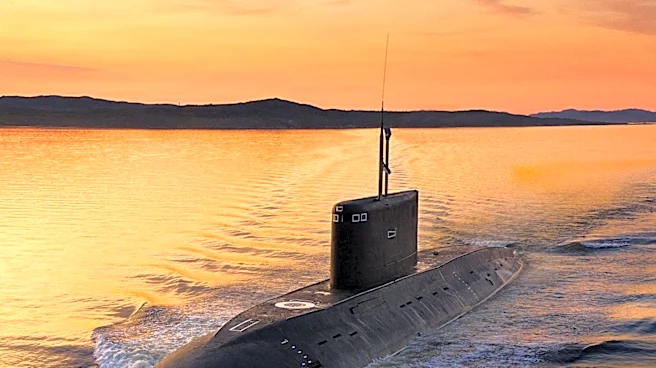
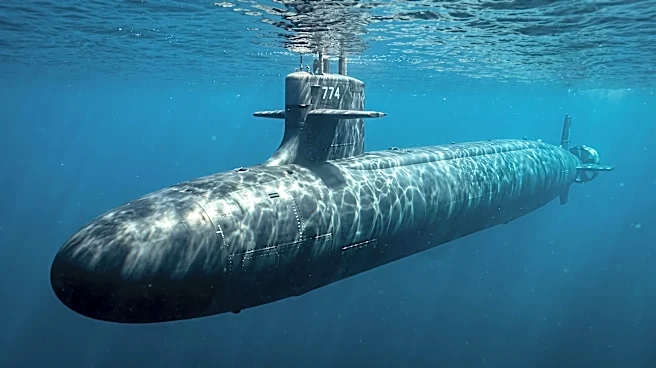
highlighted this growing threat at the Navy Submarine League’s 2026 Annual Symposium. China has introduced eight Type 093B Shang III nuclear attack submarines in less than four years, with projections suggesting an additional 20-40 similar vessels over the next decade. These Chinese submarines feature improved acoustic quieting, propulsion changes, and vertical launch cells. Russia continues to invest in advanced underwater weapons, including Borei-class ballistic missile submarines and Yasen-class guided-missile submarines, known for their stealth and missile capabilities. Russia is also developing the Poseidon nuclear-powered, nuclear-armed autonomous underwater vehicle. In response, the U.S. Navy is planning to design a new, faster attack submarine, SSN(X), to succeed the Virginia class, with construction slated to begin in the early 2040s. This new submarine is intended to preserve the U.S. undersea advantage by mid-century.
Why It's Important?
The expansion and modernization of Chinese and Russian submarine fleets pose a significant challenge to the U.S. Navy's ability to maintain undersea awareness and superiority, particularly across the vast Pacific. The increased number and improved capabilities of adversary submarines could complicate U.S. naval operations and strategic deterrence. China's investment in seabed mapping, underwater drones, and supporting infrastructure further enhances its undersea operational capabilities, potentially giving its submarines a tactical advantage. The U.S. Navy's development of the SSN(X) is crucial for counteracting these threats, aiming to ensure the U.S. retains its technological edge in underwater warfare. The high cost, estimated at around $9 billion per SSN(X) submarine, underscores the substantial investment required to maintain national security and project power in a contested maritime domain. Failure to keep pace could jeopardize U.S. naval dominance and global security interests.
What's Next?
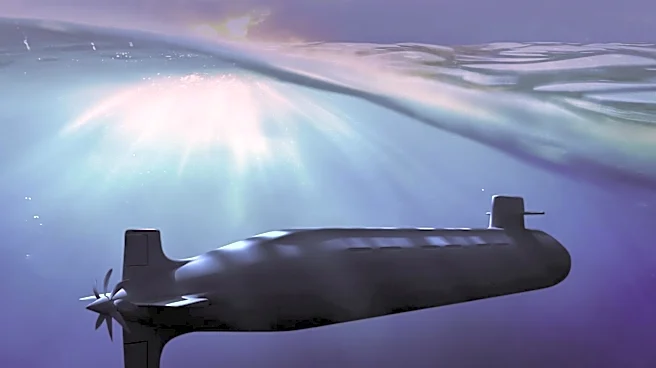
The U.S. Navy's SSN(X) program is moving forward, with the analysis of alternatives nearing completion and preliminary requirements outlined. Construction is projected to begin in the early 2040s. The Navy aims for the SSN(X) to have higher top and tactical speeds, greater operational availability, enhanced stealth, and the ability to carry and control uncrewed and autonomous systems, effectively transforming it into a 'mothership' for underwater drones. This shift in design philosophy will require significant technological advancements and industrial base investments. Concurrently, the Columbia-class submarine program, designed to replace the Ohio-class ballistic missile submarines, is back on track for the first delivery in 2028, following efforts to address construction delays through 24-hour shift operations, wage increases, and improved coordination with suppliers. These efforts are critical for maintaining the sea-based leg of the U.S. nuclear triad.
Beyond the Headlines
The escalating competition in undersea capabilities highlights a broader geopolitical shift towards a multi-polar world where naval power, particularly submarine warfare, plays a critical role in strategic deterrence and power projection. The emphasis on integrating autonomous underwater vehicles (AUVs) into future submarine designs, such as the SSN(X), signifies a fundamental change in naval strategy, moving beyond traditional manned platforms to a more networked and distributed approach. This evolution raises ethical and legal questions regarding the command and control of autonomous weapons systems in conflict scenarios. Furthermore, the substantial financial commitment to these advanced submarine programs reflects a long-term strategic investment in maintaining a technological advantage, potentially diverting resources from other defense priorities or domestic needs. The development also underscores the importance of a robust and innovative defense industrial base to support such complex and costly endeavors.