

What's Happening?
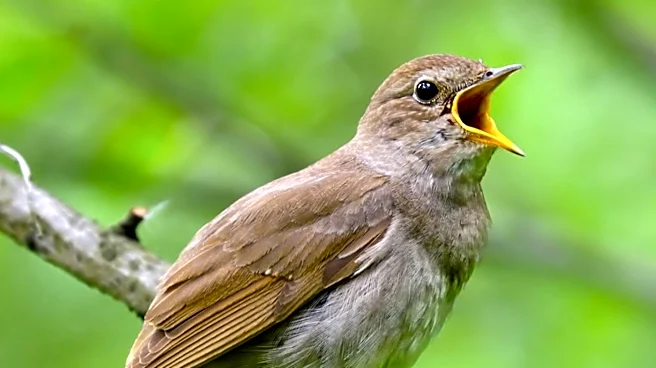
A recent study conducted by researchers from the University of Alberta, the University of Lethbridge, and the Catholic University of Chile has uncovered that certain songbird species have developed enhanced sensory abilities to dehusk seeds. The study,
published in the Proceedings of the Royal Society B, examined the brains of 92 songbird species and found that those capable of dehusking seeds have larger sensory brainstem nuclei, particularly the principal sensory nucleus of the trigeminal nerve (PrV), which processes touch information. This adaptation allows these birds to manipulate seeds with their beaks and tongues, a skill that does not rely on stronger motor movements but rather on a heightened sense of touch.
Why It's Important?
The findings of this study provide valuable insights into the evolution of sensory systems in birds, particularly how behavior can drive changes in brain structure. Understanding the neural correlates of seed-eating in songbirds can shed light on the broader mechanisms of evolution and adaptation in animals. This research highlights the role of sensory processing in the development of complex behaviors, offering a model for studying similar adaptations in other species. The study's implications extend to fields such as evolutionary biology, neuroscience, and animal behavior, contributing to a deeper understanding of how animals interact with their environments.
What's Next?
Future research may focus on examining the distribution of touch receptors in the tongues of different songbird species to further understand the sensory adaptations that facilitate seed dehusking. Additionally, researchers may explore similar behaviors in other bird species, such as parrots, to compare the neural adaptations across different avian groups. These studies could enhance our knowledge of convergent evolution and the role of sensory systems in the development of dexterous behaviors, potentially leading to new insights into the evolution of complex traits in animals.