






What's Happening?
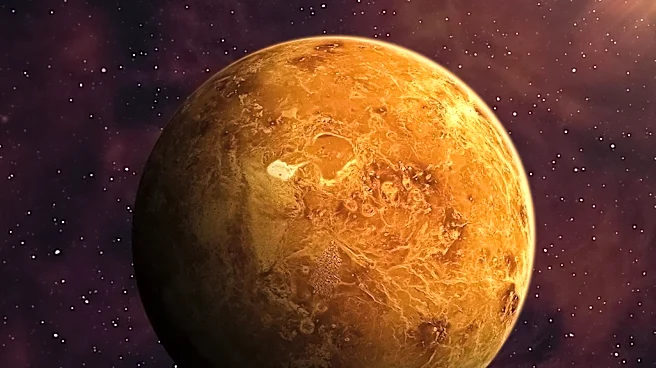
Astronomers have identified a new exoplanet, GJ 523b, which is approximately 23.5 times the mass of Earth but only 2.55 times its radius. This high density suggests that GJ 523b is predominantly rocky with a relatively small amount of gas in its atmosphere,
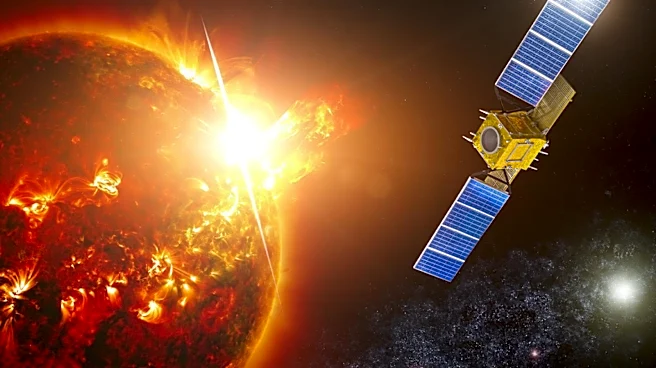
leading researchers to informally categorize it as a 'mega-Earth.' The planet orbits its star in 17.75 days, and its system is estimated to be nearly 170 million years old. The exoplanet candidate was initially detected by NASA’s TESS satellite, which observes periodic dips in stellar brightness caused by transiting planets. Subsequent observations using the ground-based 3.5-meter WIYN telescope at Kitt Peak Observatory in Arizona allowed scientists to measure the planet’s gravitational influence on its star. The parameters of GJ 523b, particularly its mass exceeding the threshold where gas giants typically accumulate massive gas envelopes, present a significant challenge to current planetary formation models.
Why It's Important?
The discovery of GJ 523b is crucial for advancing the understanding of planetary formation and evolution. Current models suggest that planets exceeding approximately 20 Earth masses should rapidly accrete large gaseous envelopes, similar to Jupiter and Saturn in our solar system. However, GJ 523b's high density despite its substantial mass indicates a different formation pathway or evolutionary history. This challenges existing theories and necessitates a re-evaluation of how planets, especially massive rocky ones, form and retain their atmospheric compositions. Understanding such anomalies can lead to more refined models of planet formation, which in turn helps in predicting the types of planets that might exist in other star systems and their potential for habitability. The existence of 'mega-Earths' like GJ 523b expands the known diversity of exoplanets, providing valuable data points for comparative planetology and the search for Earth-like worlds.
What's Next?
Further research will focus on refining the characterization of GJ 523b's atmospheric composition and internal structure to better understand its formation. Scientists will likely use advanced telescopes and spectroscopic techniques to analyze its atmosphere for traces of gas and to confirm its rocky nature. The paper describing GJ 523b has been submitted to The Astronomical Journal and is available on the arXiv preprint server, indicating that it will undergo peer review, which may lead to further scrutiny and validation of the findings. Future theoretical work will aim to develop new or modified planetary formation models that can account for the existence of such massive, dense, and rocky exoplanets. This could involve exploring scenarios like the loss of a primordial dense atmosphere or planetary collisions that could have ejected significant gas envelopes, leaving behind a rocky core. Continued exoplanet surveys will also seek to identify more 'mega-Earths' to build a larger sample size for comparative studies.
Beyond the Headlines
The existence of GJ 523b opens up intriguing possibilities for the diversity of planetary systems beyond our own. If massive rocky planets can form and persist without becoming gas giants, it suggests that the conditions for rocky planet formation might be more varied than previously thought. This could have implications for the potential distribution of life in the universe, as rocky planets are generally considered more conducive to life as we know it. The challenge posed to current planetary formation models highlights the dynamic and often unpredictable nature of astrophysical processes, reminding us that our understanding of the cosmos is constantly evolving. This discovery encourages a more open-minded approach to what constitutes a 'typical' planet and reinforces the idea that the universe is full of surprises, pushing scientists to continuously refine their theories based on new observational evidence.