





What's Happening?
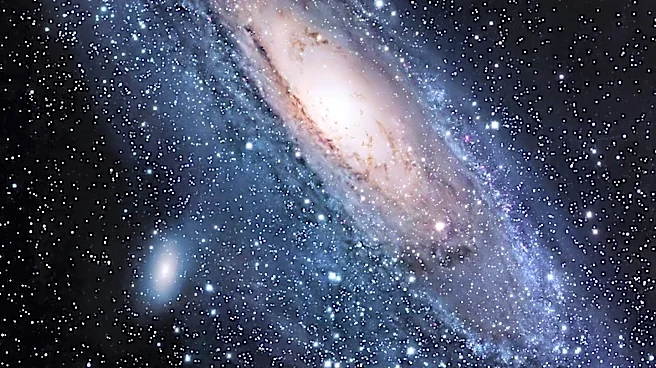
The Hubble Space Telescope has provided new insights into the Andromeda Galaxy, revealing a significant slowdown in star formation over the past 500 million years. This conclusion is drawn from over 600 Hubble exposures, which resolved approximately 200
million individual stars across two-thirds of the galaxy's disk. The study, led by astronomer Tobin Wainer from the University of Washington, indicates that Andromeda's star formation rate has decreased sharply in the last 40 million years. The research aims to understand the galaxy's past and draw parallels with the Milky Way.
Why It's Important?
Understanding the decline in star formation in Andromeda is crucial for astronomers as it provides insights into the evolutionary processes of galaxies similar to the Milky Way. The findings could help scientists predict future changes in our galaxy and others. The study also highlights the importance of advanced telescopes like Hubble in unraveling cosmic mysteries. As Andromeda is a close neighbor, it serves as a valuable model for studying galactic evolution, offering a unique perspective that is not possible with the Milky Way due to our position within it.
What's Next?
Future observations with NASA's upcoming Nancy Grace Roman Space Telescope, which offers a broader view than Hubble, are expected to provide even more comprehensive data on Andromeda. This will allow astronomers to capture the entire disk of the galaxy in a single observation, potentially revealing more about its star formation history and interactions with nearby galaxies like M32. These advancements will further enhance our understanding of galactic dynamics and the factors influencing star formation rates.