





What's Happening?
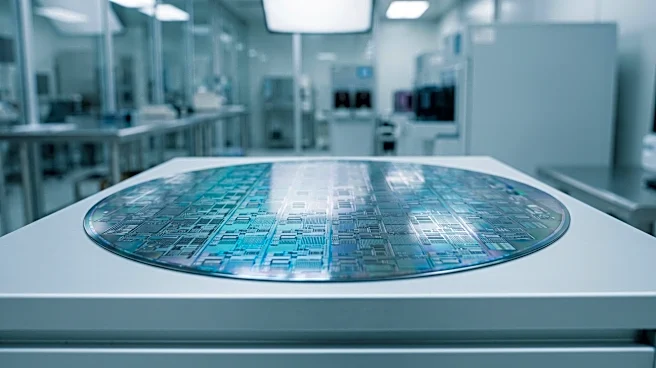
Purdue University engineers have made significant advancements in quantum computing, specifically in developing quantum photonic integrated circuits that could enable light-speed computing. This research addresses major challenges in fabricating chips
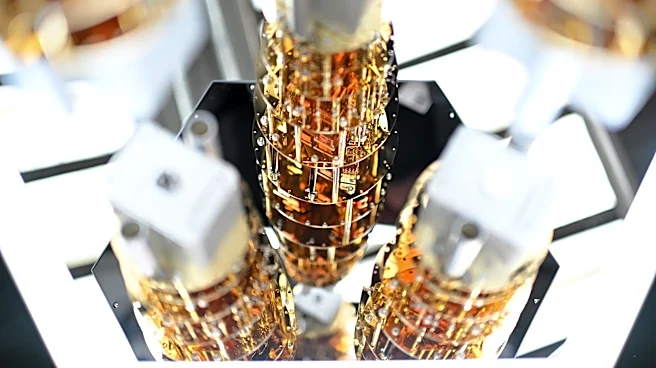
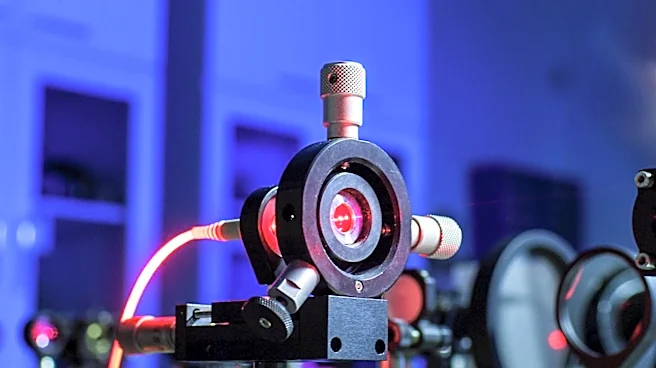
that allow photons to function as qubits, the basic units of quantum information. Photons offer advantages over other quantum particles, such as operating at the speed of light and maintaining stability at room temperature, unlike other qubits that require supercold environments. Professors Vladimir Shalaev and Alexandra Boltasseva lead the work, focusing on creating reliable single-photon sources and developing single-photon switches. Their team has demonstrated a method to emit single photons consistently using silicon nitride and has built a switch capable of operating at the single-photon level. Additionally, a team led by Professor Alexander Kildishev and graduate student Pranshu Maan has developed an approach to predict and mitigate quantum decoherence, a major source of errors in quantum calculations, using machine learning.
Why It's Important?
These advancements by Purdue University engineers are crucial for the future of quantum computing, particularly for the U.S. technology sector. The ability to build quantum computers that operate at light speed and at room temperature would dramatically reduce energy consumption and increase computational power, potentially revolutionizing fields from medicine to finance. Overcoming the challenges of fabricating quantum photonic integrated circuits on a large scale is a critical step toward practical, scalable quantum computers. The development of reliable single-photon sources and switches, along with the ability to predict and control decoherence, directly addresses fundamental hurdles that have limited the widespread adoption of quantum technology. This research positions the U.S. at the forefront of quantum innovation, fostering economic growth and national security through advanced computational capabilities.
What's Next?
The Purdue team plans to further refine their methods for predicting decoherence by incorporating physical insights from statistical physics into machine-learning models. This will improve the models' ability to anticipate and suppress decoherence, ultimately reducing the number of qubits required for quantum algorithms. The long-term goal is to develop scalable quantum architectures that can support thousands of qubits, moving beyond the current limitations of small-scale quantum photonic integrated circuits. Continued research will also focus on identifying the microscopic processes responsible for spectral shifts to enhance control over quantum states. These ongoing efforts are expected to pave the way for more robust, efficient, and practical quantum computers, potentially leading to commercial applications and further breakthroughs in various scientific and technological domains.
Beyond the Headlines
The pursuit of light-speed, room-temperature quantum computing carries profound implications beyond mere computational efficiency. It touches upon the very nature of information processing and our understanding of the physical world. The ability to manipulate individual photons as qubits at ambient temperatures could democratize access to quantum technology, moving it out of specialized, supercooled labs and into more conventional environments. This shift could accelerate innovation across industries, fostering new applications and business models that are currently unimaginable. Furthermore, the research into predicting and controlling quantum decoherence highlights the intricate dance between quantum mechanics and classical observation, pushing the boundaries of scientific inquiry and potentially leading to new fundamental discoveries about the universe. The ethical considerations surrounding such powerful computing capabilities, including data security and algorithmic bias, will also become increasingly prominent as the technology matures.