




What's Happening?
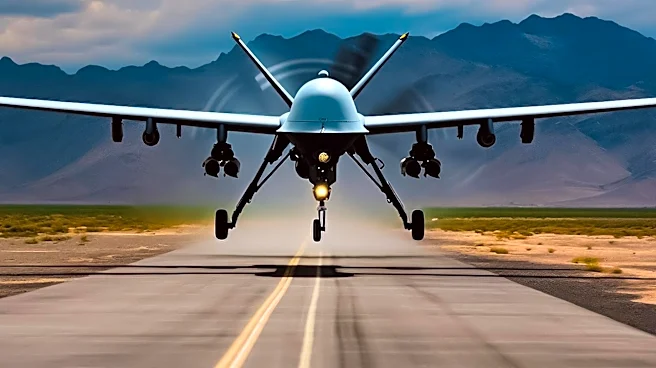
General Atomics Aeronautical Systems has unveiled 'Wildfire,' a new scalable, mission-focused, and attrition-tolerant uncrewed aircraft. This aircraft is designed to carry a greater payload, offer a longer range, and operate at a lower cost compared to its
predecessor, the MQ-9A Reaper. Wildfire leverages nearly 10 million global flight hours of General Atomics' combat-proven aircraft and incorporates novel refinements to meet evolving battlefield needs. It features multi-spectral targeting sensors and other onboard systems to provide class-leading intelligence, surveillance, and reconnaissance capabilities. The aircraft was specifically designed to accommodate a range of potent effectors, including long-range precision strike weapons. Wildfire is intended to be fielded in quantity for challenging combat operations, aiming to transform aerial warfare. It utilizes U.S. government-provided autonomy software for control, allowing human operators to manage multiple aircraft and ensuring responsiveness and resilience in combat.
Why It's Important?
The introduction of the 'Wildfire' uncrewed aircraft signifies a significant advancement in U.S. aerial warfare capabilities, particularly in terms of cost-effectiveness and operational flexibility. By offering a greater payload and longer range at a reduced cost, Wildfire could enable the U.S. military to deploy more uncrewed aircraft, increasing its presence and operational capacity in various theaters. The emphasis on attrition tolerance suggests a strategic shift towards systems that can be deployed in high-risk environments without prohibitive financial consequences, potentially altering the calculus of engagement for adversaries. The use of advanced mission autonomy and U.S. government-provided software also highlights a move towards more integrated and efficient command and control systems, reducing the labor burden on crews and enhancing the ability to respond rapidly to dynamic combat situations. This development could strengthen the U.S.'s technological edge in defense and intelligence operations.
What's Next?
The 'Wildfire' aircraft is poised to be integrated into U.S. military operations, with its design allowing for deployment in significant numbers. The focus on U.S. government-provided autonomy software suggests ongoing development and refinement of these control systems to maximize efficiency and operational effectiveness. Future steps will likely involve further testing, integration into existing military frameworks, and potential deployment in various operational scenarios to demonstrate its full capabilities. The aircraft's ability to carry long-range precision strike weapons indicates a trajectory towards enhancing offensive capabilities while maintaining a cost-effective and resilient platform. The transformation of aerial warfare, as envisioned by General Atomics, will depend on the successful implementation and widespread adoption of such advanced uncrewed systems.
Beyond the Headlines
The development of 'Wildfire' reflects a broader trend in military technology towards uncrewed systems that prioritize scalability, cost-efficiency, and advanced autonomy. This shift has profound implications for military strategy, potentially leading to a re-evaluation of traditional manned aircraft roles and a greater reliance on AI-driven platforms. The concept of 'attrition tolerance' also raises ethical and strategic questions about the willingness to deploy systems that are designed to be expendable, potentially lowering the threshold for engagement in certain conflicts. Furthermore, the reliance on U.S. government-provided autonomy software underscores the critical importance of cybersecurity and the need to protect these systems from adversarial interference. The long-term impact could include a significant restructuring of defense budgets and a redefinition of what constitutes air superiority in future conflicts.