



What's Happening?
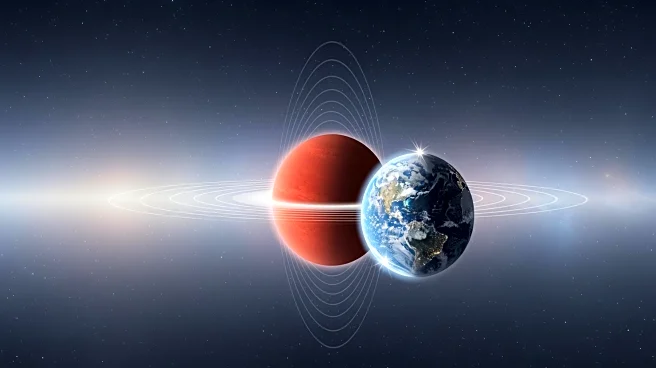
A recent study led by Stephen Kane at the University of California, Riverside, has revealed that Mars, despite its small size, has a significant impact on Earth's climate cycles, particularly those that lead to ice ages. The research involved simulations
to assess the influence of Mars's mass on Earth's orbit. The findings suggest that Mars's gravitational pull affects the eccentricity of Earth's orbit and the tilt of its axis, which are crucial factors in determining the timing and intensity of ice ages. The study found that removing Mars from the solar system would eliminate certain long-term climate cycles on Earth, while increasing Mars's mass would intensify these cycles. This research highlights the unexpected role of smaller planets like Mars in shaping the climate of larger planets.
Why It's Important?
The study's findings have significant implications for understanding Earth's climate history and predicting future climate patterns. By demonstrating Mars's influence on Earth's climate cycles, the research suggests that even small celestial bodies can have profound effects on planetary climates. This insight is crucial for the study of exoplanets, as it indicates that the presence and characteristics of smaller planets in a solar system could impact the habitability of Earth-like planets. The research underscores the need for a comprehensive understanding of the orbital architectures of exoplanet systems to accurately assess their climate dynamics and potential for supporting life.
What's Next?
Future research will likely focus on further exploring the gravitational interactions between planets and their effects on climate cycles. Scientists may also investigate the influence of other small planets in our solar system and beyond, to better understand their roles in shaping planetary climates. Additionally, the study's findings could inform the search for habitable exoplanets by emphasizing the importance of considering the gravitational effects of smaller planets in exoplanetary systems. This could lead to more accurate models of climate dynamics on distant worlds, aiding in the identification of planets with conditions suitable for life.
Beyond the Headlines
The study raises intriguing questions about the interconnectedness of celestial bodies and their collective impact on planetary environments. It challenges the traditional view that only large planets have significant gravitational influences, highlighting the need to consider the cumulative effects of smaller bodies. This research could also inspire new approaches to studying climate change on Earth, by providing a broader context for understanding the natural cycles that have shaped our planet's climate over millions of years. The findings may also prompt a reevaluation of the role of smaller planets in the evolution of solar systems, potentially leading to new insights into the formation and development of planetary systems.