







What's Happening?
A new paper in the American Economic Journal: Macroeconomics by Julien Acalin and Laurence Ball re-examines the significant reduction in the U.S. federal public debt-to-GDP ratio from over 100% in 1946 to 23% by 1974. Contrary to a common belief that
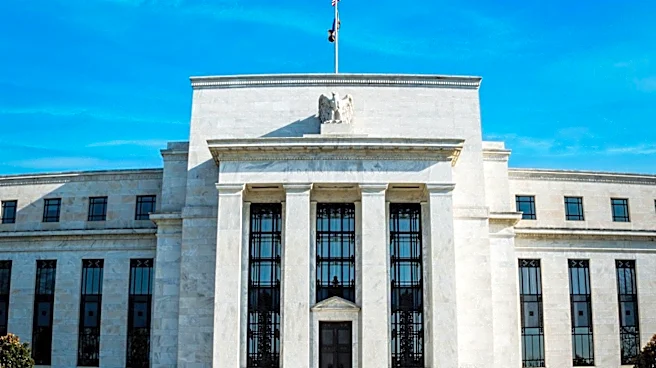
economic growth alone was the primary driver, the authors contend that historical contingencies and specific distortions played a crucial role. They identify three key factors: government primary surpluses, which involved taxes exceeding government spending to pay off war debt; the Federal Reserve's interest rate peg from 1942 to 1951, which capped government bond yields at low levels; and surprise inflation, which eroded the real value of nominal government debt. Acalin stated that the distortion effect, particularly from interest rates, was massive, accounting for approximately 40 percentage points of the debt-to-GDP ratio reduction. The study concludes that without these surpluses and distortions, the debt-to-GDP ratio would have only fallen to 74% by 1974, rather than 23%.
Why It's Important?
This research challenges a long-held economic narrative regarding how the U.S. managed its post-World War II debt. The finding that economic growth alone was not sufficient to reduce the debt burden has significant implications for current fiscal policy and future economic planning. If the mechanisms that facilitated debt reduction in the mid-20th century—such as a Federal Reserve interest rate peg and surprise inflation—are unlikely to recur, then relying on economic growth to resolve today's debt challenges may be unrealistic. The authors highlight that the average maturity of U.S. debt is now shorter, making it less susceptible to inflation surprises, and the Federal Reserve's commitment to independence and low inflation makes deliberate debt erosion improbable. This suggests that policymakers may need to consider more direct fiscal measures, such as sustained primary surpluses, to address the current high debt-to-GDP ratio, which now exceeds its postwar peak.
What's Next?
The implications of this study suggest a need for a re-evaluation of current U.S. debt management strategies. With the interest rate and growth rate currently balanced and the Congressional Budget Office projecting persistent primary deficits, the historical analogy of growing out of debt is deemed a poor guide for the present. Policymakers and economists may need to explore alternative or more aggressive approaches to fiscal responsibility. This could involve difficult decisions regarding government spending, taxation, or a combination of both, to generate primary surpluses. The study implicitly warns against complacency, indicating that without the 'special tricks' of the past, the current debt burden will not resolve itself through natural economic tendencies. Future discussions on national debt are likely to incorporate these findings, potentially leading to renewed calls for fiscal discipline and structural reforms to ensure long-term financial stability.
Beyond the Headlines
The study's findings extend beyond mere economic statistics, touching upon the ethical and political dimensions of debt management. The concept of 'surprise inflation' eroding the real value of debt, while economically effective in the past, raises questions about the fairness to creditors and the potential for moral hazard if such strategies were intentionally pursued today. The Federal Reserve's independence, a cornerstone of modern monetary policy, is highlighted as a barrier to repeating past debt reduction tactics like interest rate pegs. This underscores the evolving relationship between fiscal and monetary authorities and the constraints on using monetary policy to solve fiscal problems. The research also implicitly emphasizes the importance of transparent and sustainable fiscal policies, as relying on unforeseen economic 'tricks' is not a viable long-term strategy. It prompts a deeper societal conversation about intergenerational equity, as current debt burdens will ultimately be borne by future generations if not addressed proactively through responsible governance.