
What's Happening?
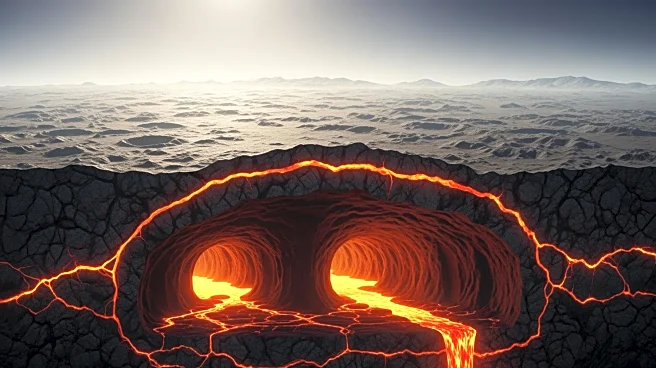
Recent studies have revealed the possibility of massive underground lava tubes on Venus, potentially spanning up to a kilometer in width. These structures, formed by flowing magma, suggest both past and
present geologic activity on the planet. The thick atmosphere of Venus makes direct observation challenging, but radar and spectroscopy have provided hints of outgassing events and thermal anomalies. The research indicates that regions like Maat Mons and Idunn Mons show surface changes that may reflect ongoing volcanic processes. This discovery raises the stakes for upcoming space missions aimed at exploring Venus's geologic history and current activity.
Why It's Important?
The discovery of potential underground lava tubes on Venus is significant for understanding the planet's geologic processes and history. If confirmed, these structures could reshape scientific perspectives on volcanic activity in extreme planetary environments. The findings also have implications for future space missions, as they provide new targets for exploration and study. Understanding Venus's volcanic activity could offer insights into similar processes on Earth and other planets, contributing to broader knowledge of planetary science. Additionally, the research highlights the challenges and advancements in remote sensing technologies used to study distant celestial bodies.
What's Next?
Future space missions to Venus may focus on confirming the existence of these underground structures and studying their implications for the planet's geologic activity. Advanced radar and spectroscopy techniques will be crucial in overcoming the observational challenges posed by Venus's thick atmosphere. The findings may also prompt further research into the planet's volcanic history and its impact on atmospheric conditions. As scientists continue to explore Venus, the potential for discovering new geologic phenomena remains high, offering opportunities for collaboration and innovation in planetary science.