
What's Happening?
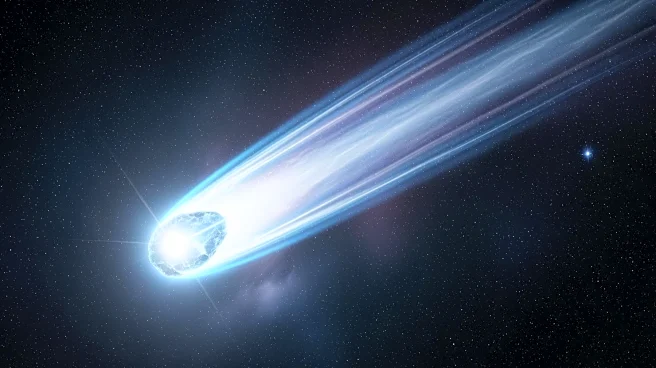
NASA is gearing up for the close approach of Comet 3I/ATLAS, an interstellar comet set to pass by Earth on December 19, 2025. This comet, only the third confirmed interstellar object to enter our solar
system, will be approximately 170 million miles away at its closest point. Despite the distance, astronomers are excited about the opportunity to study the comet's composition and behavior, which could provide insights into other planetary systems. Observers are advised to use telescopes with at least a 30-centimeter aperture to view the comet, as it will not be visible to the naked eye. The comet's path and characteristics are being closely monitored, with NASA emphasizing its scientific importance due to its differences from solar-system comets.
Why It's Important?
The flyby of Comet 3I/ATLAS presents a unique scientific opportunity to study an object from outside our solar system. Understanding its composition and behavior can offer valuable insights into the formation and characteristics of other planetary systems. This event allows researchers to gather data that could enhance our knowledge of interstellar objects and their interactions with solar systems. The comet's approach is a rare chance for coordinated observation, involving various space telescopes and Mars-based spacecraft, highlighting the significance of interstellar visitors in expanding our understanding of the universe.
What's Next?
Following its closest approach, Comet 3I/ATLAS will continue its journey out of the solar system. Observations will persist until spring 2026, with telescopes and spacecraft tracking its path beyond the giant planets. The data collected during this period will be analyzed to deepen our understanding of interstellar comets and their potential differences from those originating within our solar system. This ongoing study will contribute to the broader field of astronomy and the exploration of cosmic phenomena.