





What's Happening?
U.S. labor unions, particularly those affiliated with the Climate Jobs National Resource Center (CJNRC), are actively fighting to secure and expand unionized jobs in the clean energy sector, especially offshore wind, despite opposition from President
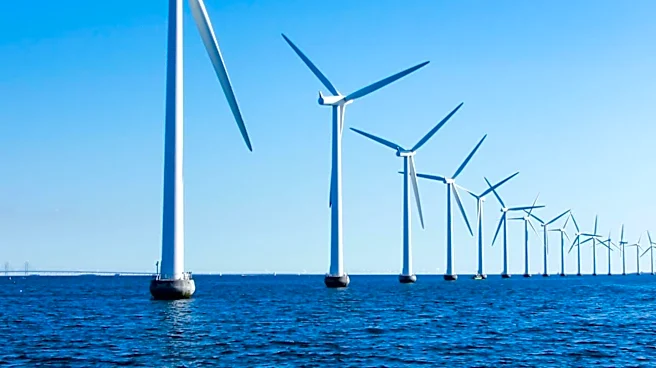
Trump. Ryan McElroen, an International Brotherhood of Electrical Workers (IBEW) Local 3 member, exemplifies the shift, having transitioned from subway work to offshore wind construction. The CJNRC, formed in 2020, has been instrumental in building labor-led climate coalitions, securing strong labor standards for clean energy projects in states like New York, Connecticut, Illinois, Rhode Island, Maine, and Texas. These efforts gained significant momentum under President Biden's Inflation Reduction Act (IRA), which provided incentives for clean energy projects meeting prevailing-wage and apprenticeship requirements. However, President Trump, upon re-election in 2024, moved to dismantle these gains, targeting offshore wind projects with stop-work orders and claiming they cause environmental harm. While courts blocked these orders, leading to the continuation of projects like Vineyard Wind and Revolution Wind, President Trump's actions have had a "chilling effect" on future offshore wind development, resulting in a projected significant reduction in new capacity and a loss of billions of work hours.
Why It's Important?
This situation highlights a critical intersection of labor rights, environmental policy, and political influence in the U.S. The push by unions for high-quality, unionized clean energy jobs demonstrates a strategic alignment between labor interests and climate action, challenging the traditional narrative that workers must choose between good jobs and environmental protection. The success of the IRA in incentivizing such jobs underscores the role of federal policy in shaping economic and environmental outcomes. Conversely, President Trump's efforts to undermine offshore wind development illustrate the vulnerability of nascent industries to political shifts and the potential for significant economic disruption, including job losses and reduced investment in domestic supply chains. The long-term impact could be a slower transition to clean energy and a weakening of the U.S.'s competitive position in this global sector, affecting both economic growth and climate goals.
What's Next?
Despite the setbacks caused by President Trump's administration, unions and environmental groups are continuing their advocacy for clean energy jobs. The CJNRC has expanded its reach, launching climate jobs coalitions in additional states and internationally, and continues to push for policies supporting clean energy employment. Labor leaders like Mike Fishman believe that the growth of offshore wind is inevitable due to its potential to generate large amounts of electricity near coastal demand centers, and they are prepared to fight for workers' rights when the sector revives. The ongoing legal and political battles surrounding clean energy projects will likely continue to shape the pace and nature of the U.S. energy transition. Future administrations and legislative actions will play a crucial role in determining whether the U.S. can regain momentum in offshore wind development and other clean energy sectors, and whether the emphasis on unionized, high-quality jobs will be sustained.
Beyond the Headlines
The conflict over offshore wind development reveals deeper ideological divides within U.S. politics regarding economic priorities and environmental stewardship. President Trump's rhetoric, which frames clean energy as detrimental to the economy and job creation, taps into concerns about traditional industries and employment. In contrast, the union movement's embrace of clean energy, particularly with strong labor standards, represents a significant evolution in their approach to climate policy, demonstrating a potential pathway for a 'just transition' that benefits workers. This ongoing struggle also underscores the importance of public perception and political messaging in shaping the future of energy policy. The "chilling effect" on investment, even when legal challenges are overcome, illustrates how political uncertainty can deter long-term economic development. The long-term success of the clean energy transition in the U.S. will depend not only on technological advancements and economic incentives but also on the ability to forge broad political and social consensus.