



What's Happening?
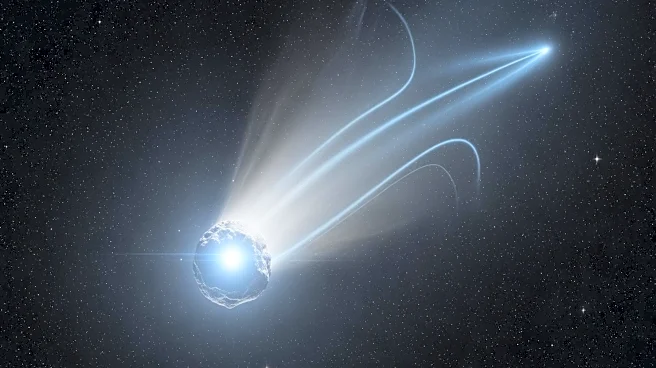
The interstellar comet 3I/ATLAS is approaching Earth, expected to come within 167 million miles. This comet, first observed by NASA's Hubble Space Telescope on July 21, has intrigued scientists due to a peculiar feature: a second tail that points towards
the Sun, contrary to the typical behavior of solar system comets. This 'anti-tail' is believed to result from enhanced mass loss on the Sun-facing side, causing larger fragments to break off and accumulate. These fragments are less affected by solar radiation pressure, leading to the unusual tail formation. Despite some speculation about the comet's nature, including theories of it being an alien spacecraft, most scientists, including UCLA's David Jewitt, attribute the phenomenon to typical cometary behavior, where dust particles are ejected towards the Sun due to sublimation on the hot side of the nucleus.
Why It's Important?
The observation of 3I/ATLAS provides a unique opportunity for astronomers to study an interstellar object with unusual characteristics. Understanding the behavior of such comets can offer insights into the dynamics of interstellar objects and their interactions with solar radiation. The phenomenon challenges existing models of cometary behavior, prompting further research into the effects of solar radiation on comet tails. This could have broader implications for our understanding of cometary physics and the processes governing the solar system. Additionally, the debate over the comet's nature highlights the importance of keeping an open mind in scientific inquiry, as unexpected findings can lead to new discoveries.
What's Next?
As 3I/ATLAS makes its closest approach to Earth, astronomers will continue to observe the comet using both ground-based and space telescopes. These observations will help determine the composition and behavior of the comet's unusual tail. The scientific community is likely to engage in further analysis and discussion to understand the underlying mechanisms causing the anti-tail. Future studies may focus on comparing 3I/ATLAS with other interstellar objects to identify common features and differences. The ongoing research could lead to revisions in existing cometary models and enhance our knowledge of interstellar phenomena.
Beyond the Headlines
The presence of an anti-tail in 3I/ATLAS raises questions about the diversity of cometary structures and the factors influencing their formation. This phenomenon may prompt a reevaluation of how solar radiation and wind interact with cometary materials. The event also underscores the potential for interstellar objects to exhibit behaviors not commonly seen in solar system comets, suggesting a need for more comprehensive models that account for a wider range of variables. The scientific discourse surrounding 3I/ATLAS exemplifies the dynamic nature of space exploration and the continuous evolution of our understanding of the cosmos.